Hiring the right people has always been difficult. The challenge becomes even greater when businesses need specialized talent, want to hire quickly, or have to evaluate hundreds of potential candidates without compromising quality.
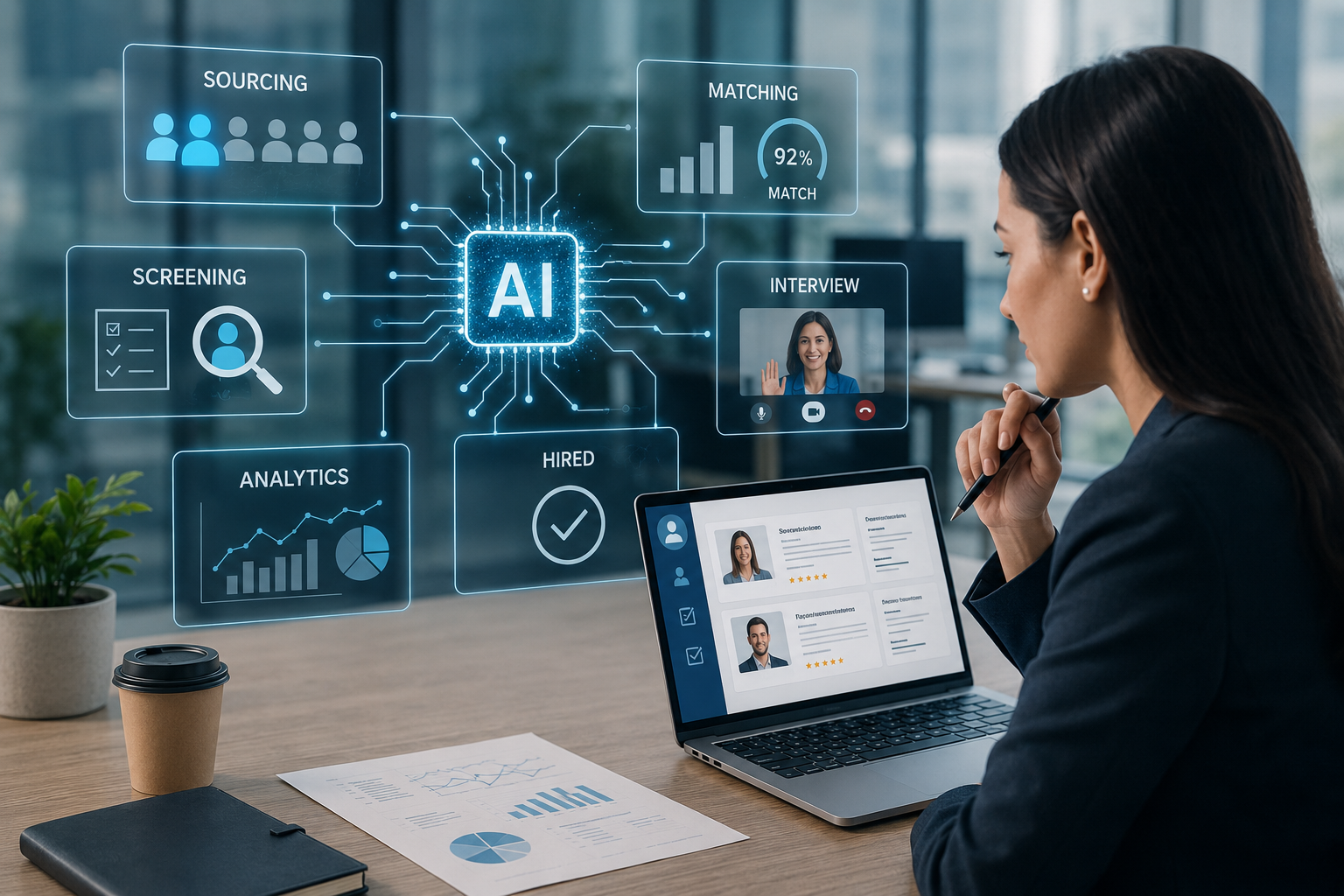
An AI-native recruitment agency combines artificial intelligence with experienced human recruiters to improve candidate sourcing, screening, matching, and hiring decisions. Unlike a traditional agency that may use AI for a few isolated tasks, an AI-native agency builds AI into the recruitment workflow from the beginning.
When choosing an AI Recruitment Agency, businesses should evaluate more than automation or promised hiring speed. The most important factors include candidate relevance, matching accuracy, recruiter expertise, human oversight, technology capabilities, data security, integrations, reporting, scalability, pricing, time-to-hire, and quality of hire.
This buyer’s guide explains what to evaluate—and what questions to ask—before selecting an AI Talent Agency.
What Is an AI-Native Recruitment Agency, and How Is It Different From a Traditional Recruitment Agency?
An AI-native recruitment agency is a recruitment company where artificial intelligence is integrated throughout the hiring workflow, including talent discovery, candidate matching, screening, recruiter decision support, and hiring analytics. Human recruiters remain involved in evaluating candidates, understanding hiring requirements, and making contextual decisions.
This is different from simply being an agency that “uses AI.”
A traditional recruitment company might use ChatGPT to write job descriptions, an AI email tool for outreach, or an applicant tracking system with a few automated features. Those tools may improve productivity, but they do not necessarily make the company AI-native.
A genuinely AI-native recruitment model uses technology as part of its core operating system.
| Area | Traditional Recruitment Agency | Agency Using AI Tools | AI-Native Recruitment Agency |
|---|---|---|---|
| Candidate sourcing | Recruiter-led | Recruiter-led with automation | AI-assisted discovery and recruiter validation |
| Screening | Mostly manual | Some automated screening | Structured AI-assisted screening |
| Candidate matching | Recruiter judgment | Keyword/ATS recommendations | Skills, experience and contextual matching |
| Outreach | Mostly manual | AI-assisted messages | Automated personalization with recruiter oversight |
| Analytics | Basic hiring reports | Tool-dependent | Integrated recruitment analytics |
| Human recruiters | Central | Central | Central, supported by AI |
| AI role | Limited | Added to existing processes | Embedded across the recruitment workflow |
The distinction matters because buying several AI subscriptions does not automatically create an intelligent recruitment system.
AI-native recruitment should mean that technology and recruiter expertise work together throughout the hiring process—not that human judgment has been removed from hiring.
How Do I Choose the Right AI Recruitment Agency for My Business?
Choose an AI recruitment agency by first defining your hiring goals and then evaluating the agency’s sourcing capabilities, AI matching technology, recruiter expertise, candidate quality, human oversight, security practices, integrations, reporting, pricing, scalability, and measurable hiring outcomes.
Start with the hiring problem rather than the technology.
For example, a company hiring 30 software engineers has very different requirements from a business searching for one senior AI architect.
Before contacting agencies, define:
- Roles you expect to hire
- Required skills and experience
- Expected hiring volume
- Geographic requirements
- Remote, hybrid, or onsite requirements
- Target time-to-hire
- Current sourcing challenges
- Existing ATS or HR technology
- Hiring budget
- What a successful hire looks like after 3–12 months
This gives you a consistent framework for comparing agencies.
Avoid choosing an agency simply because it promises to “find candidates using AI.” Ask exactly where AI is used, what decisions it influences, and where humans remain involved.
What Should I Look for in an AI-Powered Recruitment Agency?
A strong AI-powered recruitment agency should combine advanced candidate discovery and matching technology with experienced recruiters, transparent processes, measurable results, secure data handling, human oversight, and the ability to integrate with your existing hiring workflow.
Evaluate the following areas carefully.
1. AI Capabilities
Ask which parts of recruitment actually use AI.
Potential applications include:
- Candidate sourcing
- Resume analysis
- Skills extraction
- Candidate-role matching
- Candidate ranking
- Personalized outreach
- Interview assistance
- Recruitment analytics
- Talent-pool discovery
The agency should be able to explain these capabilities without relying on vague terms such as “proprietary AI” or “advanced algorithms.”
2. Candidate Sourcing
Technology is valuable only if the agency can access relevant talent.
Ask where candidates come from and whether sourcing covers:
- Existing talent networks
- Professional platforms
- Internal databases
- Publicly available professional data
- Referrals
- Active applicants
- Passive candidates
For specialist roles, talent-pool depth may matter more than the number of profiles an AI system can process.
3. Matching Accuracy
Ask how the system determines whether someone is suitable for a role.
Basic matching might rely heavily on job titles and keywords. More sophisticated systems may consider skills, experience, seniority, industry background, project history, location, availability, and other job-relevant criteria.
More candidates do not necessarily mean better recruitment.
The useful output of an AI recruitment system is not the number of profiles processed—it is the number of genuinely relevant candidates surfaced for human evaluation.
4. Recruiter Expertise
AI does not eliminate the need for recruiters who understand your market.
Evaluate whether recruiters have experience hiring for your:
- Industry
- Technical domain
- Seniority levels
- Geography
- Hiring model
This becomes particularly important when recruiting technical specialists or senior leadership.
5. Human Oversight
Ask where humans enter the process.
Recruiters should be able to review AI recommendations, challenge rankings, investigate unusual results, speak with candidates, assess contextual factors, and provide hiring managers with informed recommendations.
The goal of AI in Hiring should be better recruiter decision-making—not blind acceptance of automated recommendations.
What Questions Should I Ask an AI Recruitment Agency Before Hiring Them?
Before hiring an AI recruitment agency, ask how its technology works, what candidate data it uses, where recruiters intervene, how matching accuracy is evaluated, how bias and privacy risks are managed, what integrations are supported, and how hiring success is measured after placement.
Useful questions include:
- Which stages of your recruitment process use AI?
- What does your AI evaluate when matching candidates with jobs?
- Where do human recruiters review AI-generated recommendations?
- How do you prevent qualified candidates from being incorrectly filtered out?
- How do you evaluate matching accuracy?
- What sources do you use for candidate discovery?
- How do you handle candidate data and privacy?
- What ATS and HR systems can you integrate with?
- How do you measure time-to-hire?
- How do you define and measure quality of hire?
- What reporting will we receive?
- How is your pricing structured?
- Can your recruitment model scale if our hiring requirements increase?
- Who owns candidate data and hiring information?
- What happens if the initial candidate shortlist does not meet expectations?
A capable provider should be able to answer these questions clearly.
How Can I Evaluate the AI Technology and Tools Used by a Recruitment Agency?
Evaluate recruitment AI by examining its inputs, matching methodology, explainability, accuracy, human review process, security controls, integrations, and real-world hiring outcomes. Do not evaluate a recruitment provider solely by the number of AI tools or models it claims to use.
You do not necessarily need access to the agency’s source code.
Instead, request a practical demonstration.
Give the agency a realistic job description and ask it to explain how candidates would be discovered, screened and ranked.
For several recommended candidates, ask:
Why was this candidate selected?
The answer should connect recommendations to job-relevant evidence such as skills, experience, projects, seniority or domain knowledge.
Also examine integration capabilities.
An agency may need to work with your:
- Applicant tracking system
- HRIS
- Calendar
- Interview scheduling tools
- Communication systems
- Hiring dashboards
Integration matters because AI Powered Recruitment becomes less valuable if your team has to manually transfer information between multiple disconnected systems.
How Do AI Recruitment Agencies Measure Quality of Hire and Hiring Success?
AI recruitment agencies should measure success using both recruitment efficiency and post-hire outcomes. Useful metrics include candidate relevance, shortlist-to-interview rate, interview-to-offer rate, offer acceptance, time-to-hire, retention, hiring-manager satisfaction, and employee performance after hiring.
Time-to-hire is useful—but it should never be the only measure.
Imagine two agencies:
Agency A: Produces 40 candidates in two days, but only three are considered interview-worthy.
Agency B: Produces 10 candidates in four days, but seven move to interviews.
Agency A is technically faster. Agency B may be creating far more value.
This is why candidate relevance and downstream outcomes matter.
LinkedIn’s Future of Recruiting 2025 research emphasizes the industry’s increasing focus on quality of hire rather than recruiting efficiency alone. The report notes that common quality-of-hire measurements include job performance, new-hire retention and hiring-manager satisfaction.
A recruitment partner should therefore establish success metrics before hiring begins and review outcomes after placements are made.
What Are the Risks of Using AI in Recruitment?
The major risks of AI in recruitment include algorithmic bias, inaccurate candidate scoring, privacy and security issues, poor transparency, over-automation, and excessive dependence on automated recommendations. These risks can be reduced through human oversight, testing, governance, secure data practices, and regular evaluation of AI-assisted decisions.
Bias
AI systems can reflect problems in their training data, historical hiring information, assumptions or evaluation criteria.
Ask agencies how they test candidate-ranking systems and whether recruiters can override automated recommendations.
Data Privacy and Security
Recruitment involves sensitive personal and professional information.
Evaluate:
- What candidate information is collected
- Why it is collected
- Where it is stored
- Who can access it
- How long it is retained
- How deletion requests are handled
- What third-party AI services process it
- What security controls protect it
Lack of Explainability
If an agency cannot explain why candidates receive particular recommendations or rankings, hiring managers may struggle to trust or audit the process.
Over-Automation
Automating every recruitment interaction can damage candidate experience and overlook context that software cannot adequately assess.
AI can process information at scale. Human recruiters bring judgment, conversation, negotiation, empathy, market knowledge and context.
For broader AI governance, the NIST AI Risk Management Framework provides a useful reference for evaluating characteristics such as reliability, transparency, privacy and fairness.
Why Should Hiring Quality Matter More Than Automation Speed?
Recruitment automation is valuable when it helps businesses identify better candidates efficiently. Speed alone is not a meaningful hiring outcome if faster automation produces irrelevant shortlists, poor candidate experiences, weak hires, or higher employee turnover.
This is an important distinction when comparing providers.
LinkedIn’s 2025 recruiting research similarly argues that recruiting excellence is increasingly being judged by quality and long-term outcomes rather than speed and short-term efficiency alone.
A useful AI Talent Agency should therefore optimize the complete hiring funnel:
Talent discovery → relevant shortlist → interviews → offers → acceptance → successful employee
Not simply:
Job posted → resumes delivered quickly
AI Recruitment Agency Buyer’s Checklist
Before signing with an AI recruitment agency, evaluate its technology, candidate network, matching quality, recruiter expertise, human oversight, integrations, security, analytics, commercial terms, scalability and ability to demonstrate measurable hiring outcomes.
Use this checklist when comparing providers.
| Evaluation Area | What to Check |
|---|---|
| ☐ AI-native capability | Is AI embedded throughout recruitment or limited to isolated tools? |
| ☐ Candidate sourcing | Can the agency reach relevant active and passive candidates? |
| ☐ Screening | How are candidate qualifications evaluated? |
| ☐ Matching accuracy | Can the agency explain why candidates match a role? |
| ☐ Candidate relevance | What percentage of shortlisted candidates typically progress? |
| ☐ Recruiter expertise | Do recruiters understand your roles and industry? |
| ☐ Human oversight | Are important AI recommendations reviewed by recruiters? |
| ☐ AI transparency | Can the agency explain where and how AI affects decisions? |
| ☐ Bias controls | How does the agency identify and manage potential bias? |
| ☐ Data security | How is candidate and company information protected? |
| ☐ Privacy | What data is collected, retained and shared with AI providers? |
| ☐ Integrations | Does the solution work with your ATS and HR technology? |
| ☐ Reporting | Can you track sourcing, interviews, offers and hiring outcomes? |
| ☐ Time-to-hire | How is hiring speed measured? |
| ☐ Quality of hire | Does the agency evaluate post-hire success? |
| ☐ Scalability | Can it support changing hiring volumes? |
| ☐ Pricing | Is pricing transparent and tied to clear deliverables? |
| ☐ Contract terms | Are replacement, cancellation and ownership terms clear? |
| ☐ Candidate experience | Does automation preserve meaningful human interaction? |
| ☐ Proof | Can the agency demonstrate relevant results or case studies? |
A Simple Five-Step Evaluation Process
Step 1: Define your hiring outcomes.
Document the roles, skills, volume, geography, timeline and quality expectations before speaking with vendors.
Step 2: Shortlist relevant agencies.
Prioritize providers with proven experience in your talent category rather than selecting based on AI branding alone.
Step 3: Test the technology.
Request a demonstration using a realistic role and examine how candidates are sourced, ranked and explained.
Step 4: Evaluate humans and technology together.
Meet the recruiters who would actually work on your account. Strong technology with weak recruiting expertise can still produce poor hiring outcomes.
Step 5: Compare measurable outcomes and commercial terms.
Review candidate relevance, expected time-to-hire, quality metrics, reporting, pricing, data policies and contract terms before deciding.
Businesses exploring an AI-native recruitment model can also review how platforms such as Ellow combine technology with recruitment expertise when evaluating different approaches to technology talent acquisition.
Choosing the right AI Recruitment Agency is not about finding the provider with the most automation.
It is about finding the best combination of technology, talent access, recruiter expertise, human judgment, transparency and measurable hiring outcomes.
AI can help recruitment teams analyze larger talent pools, identify potentially relevant candidates, reduce repetitive work and make hiring workflows more efficient. But recruitment remains a high-context process involving people, business requirements and decisions that can have long-term consequences.
The strongest AI-native recruitment model therefore uses AI where machines provide an advantage—such as data processing, discovery and pattern recognition—while keeping experienced recruiters involved where judgment, communication and context matter.
Before signing a contract, ask one final question:
Will this agency simply help us process candidates faster, or will it help us make better hires?
The answer is often the clearest indication of whether you have found the right recruitment partner.
Frequently Asked Questions
Is an AI recruitment agency better than a traditional recruitment agency?
Not automatically. An AI recruitment agency may process talent data, identify candidates and automate repetitive tasks more efficiently, but results depend on candidate access, technology quality, recruiter expertise and human oversight. Businesses should compare actual hiring outcomes rather than choosing an agency based solely on its use of AI.
Can AI completely replace recruiters?
AI can automate or assist sourcing, screening, matching, outreach and analytics, but human recruiters remain important for understanding hiring context, communicating with candidates, evaluating nuanced situations, advising hiring managers and overseeing AI-generated recommendations.
How do I know whether a recruitment agency is genuinely AI-native?
Ask the agency to demonstrate where AI operates throughout its recruitment workflow. A genuinely AI-native agency should be able to explain how AI contributes to sourcing, matching, screening or decision support and how those systems interact with human recruiters.
What is the most important metric when comparing AI recruitment agencies?
There is no single universal metric, but candidate relevance and quality of hire should receive significant weight. Time-to-hire matters, but faster recruitment creates limited value if shortlisted candidates are unsuitable or new hires perform poorly.
Should a small business use an AI Talent Agency?
It can make sense when a small business lacks internal recruiting capacity, needs specialist talent, or wants access to a broader candidate pool. The business should still compare agency fees against hiring volume, role complexity and the cost of leaving positions vacant.
What should I request before signing an AI recruitment contract?
Request clear information about pricing, deliverables, replacement policies, candidate ownership, data processing, reporting, integrations, recruiter responsibilities, AI usage, performance expectations and termination terms.