Let’s buildthe future together.
Great ideas need great people. Partner with us to bring your vision to life, or take the first step in your career by joining our team of innovators.



Receive new articles delivered Straight to your inbox
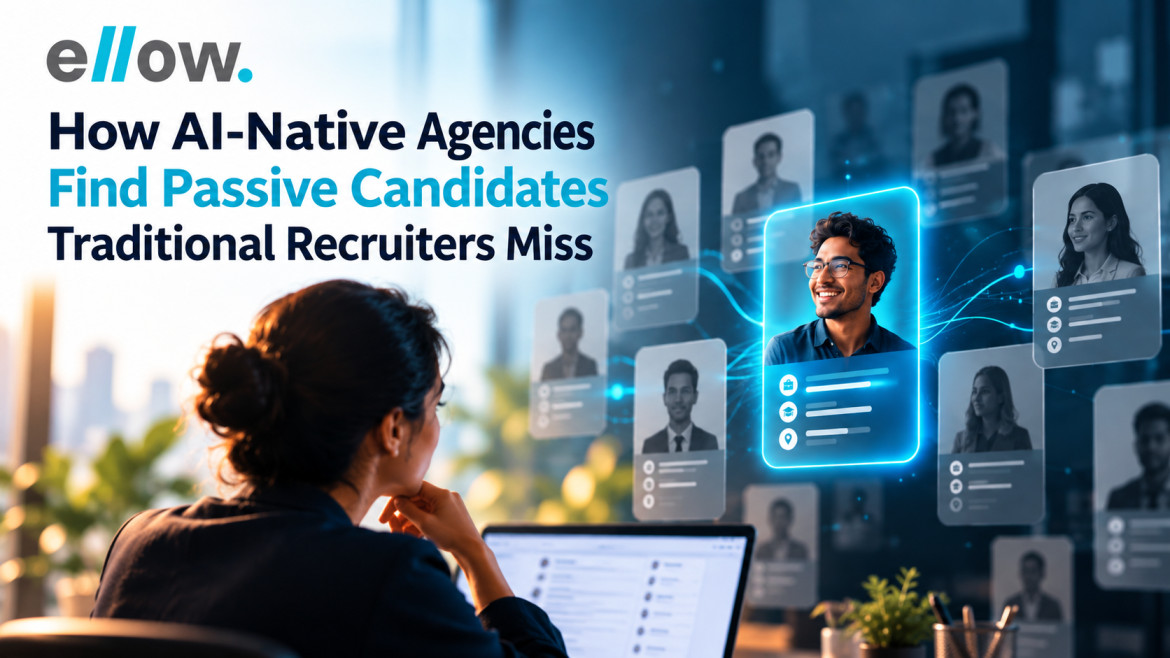
Finding the right candidate is not always about attracting more applications. Sometimes, the ideal person is already working for another company, delivering excellent results and not actively searching for a new job.
These professionals are known as passive candidates. They may be open to an interesting opportunity, but they are unlikely to apply through a conventional job advertisement or respond to a generic recruitment message.
Traditional recruitment methods often depend on job boards, keyword searches, professional networks and existing candidate databases. Although these methods remain useful, they can make it difficult to identify qualified people whose profiles do not match familiar job titles or standard search criteria.
This is where AI-native recruitment models are changing the sourcing process.
An AI Talent Agency can combine artificial intelligence, skills-based matching, structured candidate data and recruiter expertise to identify professionals who might otherwise remain undiscovered. Instead of relying exclusively on applications, an AI-driven approach can help recruitment teams search more broadly, recognise transferable skills and initiate relevant conversations with potential candidates.
In this article, we explore how AI-native agencies find passive candidates, what makes their approach different and why human judgement remains essential throughout the hiring process.
Passive candidates are professionals who are not actively applying for jobs but may consider a suitable opportunity if the right one becomes available.
They can include experienced software engineers, product managers, cybersecurity specialists, marketing leaders, data scientists, finance professionals and senior executives.
These individuals may be difficult to reach for several reasons.
For example, a company searching for a machine learning engineer may overlook a software engineer who has built and deployed machine learning systems but has never held that exact job title.
Similarly, a business looking for a growth marketing leader may miss a performance marketer who has already managed acquisition strategy, analytics and team leadership under a different title.
Finding these candidates requires more than searching for matching words. It requires understanding the skills, experience and responsibilities behind a professional’s profile.
An AI-native recruitment agency builds artificial intelligence into its core sourcing and recruitment workflows rather than using AI only for occasional tasks such as rewriting job descriptions or drafting emails.
AI may support activities such as candidate discovery, profile analysis, skills matching, talent-pool management and personalised communication.
A traditional workflow might begin with a recruiter reviewing a job description, searching a database using keywords, opening profiles individually and manually creating a shortlist.
An AI-supported workflow can help expand this process by interpreting the role requirements, exploring related skills, identifying potential matches across available data sources and summarising why a candidate may be relevant.
The distinction is not that traditional recruiters cannot find passive candidates. Experienced recruiters already use networking, research and direct outreach to identify people who are not actively applying.
The difference is how AI-native agencies can combine automation, broader searches and structured evaluation to support this work at scale.
| Traditional recruitment approach | AI-supported recruitment approach |
|---|---|
| Searches frequently begin with job titles and keywords | Searches can include related skills, responsibilities and experience |
| Recruiters may review profiles individually | AI can help prioritise profiles for human review |
| Candidate information may be spread across multiple systems | Integrated workflows can help organise available candidate information |
| Outreach may rely on reusable templates | AI can assist with role-specific, personalised drafts |
| Shortlists may depend heavily on manual research | AI can support wider discovery and structured comparisons |
| Recruiters manually repeat many research tasks | Automation can reduce repetitive work and free time for candidate conversations |
The benefits depend on the quality of the data, the recruitment tools used and how well the workflow is designed. AI does not automatically make a shortlist more accurate simply because it processes more profiles.
One of the most useful applications of AI in hiring is its ability to support searches based on meaning and related skills, rather than relying entirely on exact keyword matches.
Traditional keyword searches can be restrictive. A recruiter searching for “data analyst” may miss someone whose profile uses terms such as business intelligence, reporting specialist or analytics consultant.
AI-supported search can help identify relationships between these terms and the underlying work they describe.
An AI recruitment workflow may examine available professional information for indicators such as:
For example, imagine a company wants to hire a cloud security engineer.
Instead of searching only for that exact title, a recruiter could explore professionals with experience in cloud infrastructure, identity management, security architecture, compliance and incident response.
The search can then identify people whose experience overlaps with the role, even if their current titles differ.
AI can also help surface candidates from adjacent roles or industries.
A professional working in one industry may have skills that transfer to another, provided the required competencies and experience are present.
However, a similarity between profiles is only a starting point. Recruiters still need to verify whether the candidate’s experience meets the actual requirements of the role.
This broader approach can help an AI Recruitment Agency discover potential candidates who might be overlooked by rigid title-based searches.
Passive candidates do not all maintain the same online presence. Some are active on professional networking platforms, while others are more visible through technical communities, industry publications, project portfolios or professional associations.
AI-supported sourcing can help recruitment teams organise and analyse information from multiple permitted sources.
Depending on the tools and access available, these sources may include:
For example, a software developer’s professional profile may provide information about their current role, while a public portfolio may demonstrate experience with specific technologies.
Bringing relevant information together can help a recruiter assess whether the person merits further consideration.
However, more data does not automatically mean better recruitment. Information should be relevant to the role, collected and used lawfully, handled securely and checked for accuracy.
Agencies should also respect platform terms, candidate privacy and applicable data protection requirements. Publicly accessible information should not be treated as permission to use it for any purpose.
A professional’s online profile rarely tells the entire story. Nevertheless, available information may provide clues about their experience and areas of expertise.
AI-supported recruitment tools can help organise these clues so recruiters can decide whom to contact first.
Potentially relevant signals may include:
A candidate may have worked with the technical stack or tools required for a role, even if those skills are not prominent in their headline or job title.
Where available and appropriate to use, public project descriptions or portfolios may provide additional context about a candidate’s work.
A professional’s work history may show increasing responsibility, specialist expertise or experience coordinating projects and teams.
Candidates who have worked in related environments may bring relevant understanding of industry requirements, customer needs or operating conditions.
Some platforms provide permitted information about professional interests or engagement with career opportunities. When such information is available for recruitment use, it may help inform outreach priorities.
These indicators should be treated as leads for further assessment, not proof of a person’s ability, interest in changing jobs or willingness to be contacted.
An AI system should not infer sensitive personal characteristics or make unsupported assumptions about someone based on online activity.
Discovering a large number of profiles is only useful if recruitment teams can identify which candidates are worth evaluating.
AI-powered matching can help compare a role’s requirements with information available in candidate profiles.
A structured matching process may consider:
For example, a company hiring a senior product manager may require experience with product strategy, stakeholder management, customer research and cross-functional delivery.
A candidate with a different job title may still have relevant experience in these areas. AI can help surface that possibility, allowing a recruiter to examine the evidence more closely.
A useful recruitment system should provide more than an unexplained score.
Recruiters need to understand which job-related requirements a candidate appears to meet, what information supports that assessment and which details still need verification.
A profile match is not a hiring decision. It is a way to prioritise human review.
Candidates should not be automatically rejected simply because their profiles lack certain keywords, use different terminology or contain incomplete information.
Finding a qualified professional is only the beginning. The next challenge is initiating a conversation that is relevant, respectful and worth the candidate’s time.
Passive candidates may receive frequent recruitment messages. Generic outreach that simply repeats a job title and salary range can be easy to ignore.
AI can assist recruiters in drafting messages that connect a role with a candidate’s verified experience.
For example, an outreach message might refer to a professional’s publicly documented experience in cloud infrastructure and explain why that background appears relevant to a specific engineering opportunity.
A thoughtful message should communicate:
The recruiter should review the message before sending it, verify the facts and avoid claiming that the candidate has experience they have not demonstrated.
Personalisation should not become intrusive. Recruiters should respect communication preferences, avoid excessive follow-ups and stop contacting people who decline.
AI can make outreach preparation more efficient, but respectful communication and genuine professional relationships remain essential.
Consider a hypothetical company that needs a senior AI engineer with experience deploying machine learning systems in production.
The company has received applications, but the available candidates do not fully meet its requirements. The ideal person may already be employed and not actively searching for a new role.
An AI-native agency could approach the search through the following steps.
<text weight=”medium”>Step 1: Define the actual requirements</text>
The recruiter clarifies the essential skills, expected responsibilities, relevant experience and any non-negotiable requirements with the hiring manager.
<text weight=”medium”>Step 2: Expand the search criteria</text>
Instead of searching only for “senior AI engineer,” the agency explores related experience such as machine learning engineering, model deployment, MLOps, production systems and relevant cloud technologies.
<text weight=”medium”>Step 3: Search permitted data sources</text>
AI-supported tools help identify professionals whose available profiles contain evidence of relevant skills and experience.
<text weight=”medium”>Step 4: Review the evidence</text>
Recruiters examine the strongest potential matches, check the information and identify gaps that need clarification.
<text weight=”medium”>Step 5: Prepare personalised outreach</text>
The recruiter drafts a concise message explaining the role and why the candidate’s verified background appears relevant.
<text weight=”medium”>Step 6: Qualify interested candidates</text>
Candidates who respond can discuss their experience, interests, expectations and suitability through an appropriate human-led process.
<text weight=”medium”>Step 7: Present an evidence-based shortlist</text>
The agency shares candidates with the hiring team, explaining how their demonstrated experience aligns with the requirements and what still needs to be assessed.
This example illustrates a possible workflow, not a guaranteed result. The quality of the shortlist depends on the requirements, source coverage, available data and human evaluation.
AI can reduce time spent on certain repetitive tasks, such as expanding searches, organising profiles, summarising relevant information and preparing outreach drafts.
This can give recruiters more time for activities that require human judgement, including candidate conversations, understanding motivation, evaluating context and advising hiring managers.
However, faster sourcing does not necessarily mean faster or better hiring.
The recruitment process can still be delayed by unclear job requirements, slow feedback, compensation misalignment, interview scheduling or lengthy approval processes.
Similarly, a large AI-generated shortlist can create more work if it contains irrelevant or poorly verified profiles.
To evaluate the value of AI in hiring, organisations should track more than the number of profiles sourced.
Useful measures include:
| Recruitment metric | What it helps assess |
|---|---|
| Qualified candidates per role | Whether sourcing produces relevant profiles |
| Outreach response rate | Whether messages generate meaningful engagement |
| Recruiter screening time | Whether repetitive review work is reduced |
| Interview-to-offer ratio | Whether shortlisted candidates progress through the process |
| Offer acceptance rate | Whether opportunities align with candidate expectations |
| Candidate experience | Whether communication is timely, respectful and clear |
| Retention and hiring quality | Whether hires perform and remain in the role over time |
These measures should be interpreted in context. For example, a low response rate may reflect compensation, timing or the attractiveness of the opportunity rather than the quality of the AI system alone.
AI can improve recruitment workflows, but it also introduces risks that agencies and employers need to manage.
AI systems may reproduce patterns in historical recruitment data or use indicators that unfairly disadvantage particular groups.
Agencies should review their sourcing and evaluation criteria, test systems for potential adverse impacts and ensure that relevant candidates are not excluded because of unrelated characteristics.
AI-generated summaries may misinterpret a job title, infer skills that are not demonstrated or overlook important context.
Recruiters must verify key claims before presenting a candidate to an employer.
Candidate information should be collected and processed for legitimate recruitment purposes, with appropriate safeguards and access controls.
Agencies should understand the rules governing their data sources and the applicable privacy and employment requirements.
A candidate score may appear objective even when it depends on incomplete data or poorly designed criteria.
Recruiters should be able to explain why a person is being considered and should retain appropriate human oversight over consequential decisions.
Automated messages that feel impersonal, misleading or excessive can damage trust.
Candidates should receive accurate information and have a clear way to communicate with a human recruiter.
The UK government’s Responsible AI in Recruitment guidance discusses risks including bias, digital exclusion and the need for transparency, accountability and ongoing evaluation. These are useful considerations for any organisation adopting AI-supported recruitment. Read the guidance.
For employers looking to hire specialised or hard-to-find professionals, an AI Talent Agency should offer more than access to an automated search tool.
Before choosing a partner, consider the following questions.
How does the agency define candidate fit?
Ask whether matching is based on job-related skills, experience and clear requirements rather than superficial keyword similarity alone.
Which sources does it use?
Understand where candidate information comes from, whether the agency is permitted to use those sources and how information is verified.
How does human review work?
Find out who checks the shortlist, validates candidate experience and conducts the initial conversations.
How does it protect candidate information?
Ask about privacy, data security, retention practices and the use of AI tools by third-party providers.
How does it measure performance?
Look for meaningful measures such as qualified shortlist quality, response rates, hiring outcomes and candidate experience—not just the number of profiles discovered.
How does it communicate with passive candidates?
A good recruitment partner should use relevant, accurate and respectful outreach rather than indiscriminate messaging.
The best agency combines efficient technology with recruiter expertise, transparent processes and a clear understanding of the employer’s needs.
An AI Talent Agency uses artificial intelligence to support recruitment activities such as candidate sourcing, profile analysis, skills matching and outreach. Human recruiters may still manage candidate conversations, qualification and coordination with employers.
It can use AI-assisted searches, related-skill matching and permitted candidate data sources to identify professionals who may fit a role despite not actively applying. Recruiters then verify their experience and determine whether they are interested in discussing an opportunity.
AI in Hiring refers to the use of artificial intelligence to support parts of the recruitment process, including sourcing, job-description development, candidate communication, screening support and workflow automation. The level of automation varies by system and employer.
Neither approach is automatically better in every situation. AI can help expand searches and reduce repetitive work, while experienced recruiters contribute judgement, relationship-building and contextual understanding. Combining the two can be useful when systems are well designed and responsibly managed.
AI-supported semantic search can help identify related skills and responsibilities even when a candidate’s title differs from the job title being searched. The recruiter must still verify that the candidate’s experience meets the role’s requirements.
Not necessarily. AI may support discovery, comparison and administrative tasks, but employers should define appropriate human oversight. Candidate evaluation and hiring decisions need to consider verified evidence, job-related criteria and applicable employment requirements.
It can be useful for specialised roles where relevant experience appears under varied job titles or across different industries. Results depend on the availability and quality of candidate information, the search strategy and human qualification.
The strongest candidates are not always the people actively applying for jobs. Many experienced professionals remain outside the visible applicant pool because they are satisfied in their current positions, use different job titles or do not appear in conventional keyword searches.
An AI-native recruitment model can help address this challenge by broadening candidate discovery, identifying related skills, organising available information and supporting personalised outreach.
However, AI is most useful when it strengthens—not replaces—recruiter judgement. Accurate candidate information, fair evaluation, privacy safeguards and respectful communication remain essential to building a successful recruitment process.
For employers seeking specialised talent, an AI Recruitment Agency can offer a more structured way to explore the passive candidate market when it combines suitable technology with experienced human recruiters.
Looking for a smarter approach to talent sourcing? Explore Ellow to learn more about AI-enabled talent and recruitment solutions.

How AI-Powered Hiring Platforms Are Replacing Traditional Recruitment

India's Tech Talent Boom: Why Smart Companies Are Hiring There Now

Why Startups Fail at Tech Hiring (And How to Avoid It)
Please feel free to share your thoughts and we can discuss it over a cup of tea.
Get a quote
Software Development Outsourcing Challenges and how to solve them
Best database for web development: A developers guide

How AI-Native Agencies Find Passive Candidates Traditional Recruiters Miss
