Let’s buildthe future together.
Great ideas need great people. Partner with us to bring your vision to life, or take the first step in your career by joining our team of innovators.



Receive new articles delivered Straight to your inbox
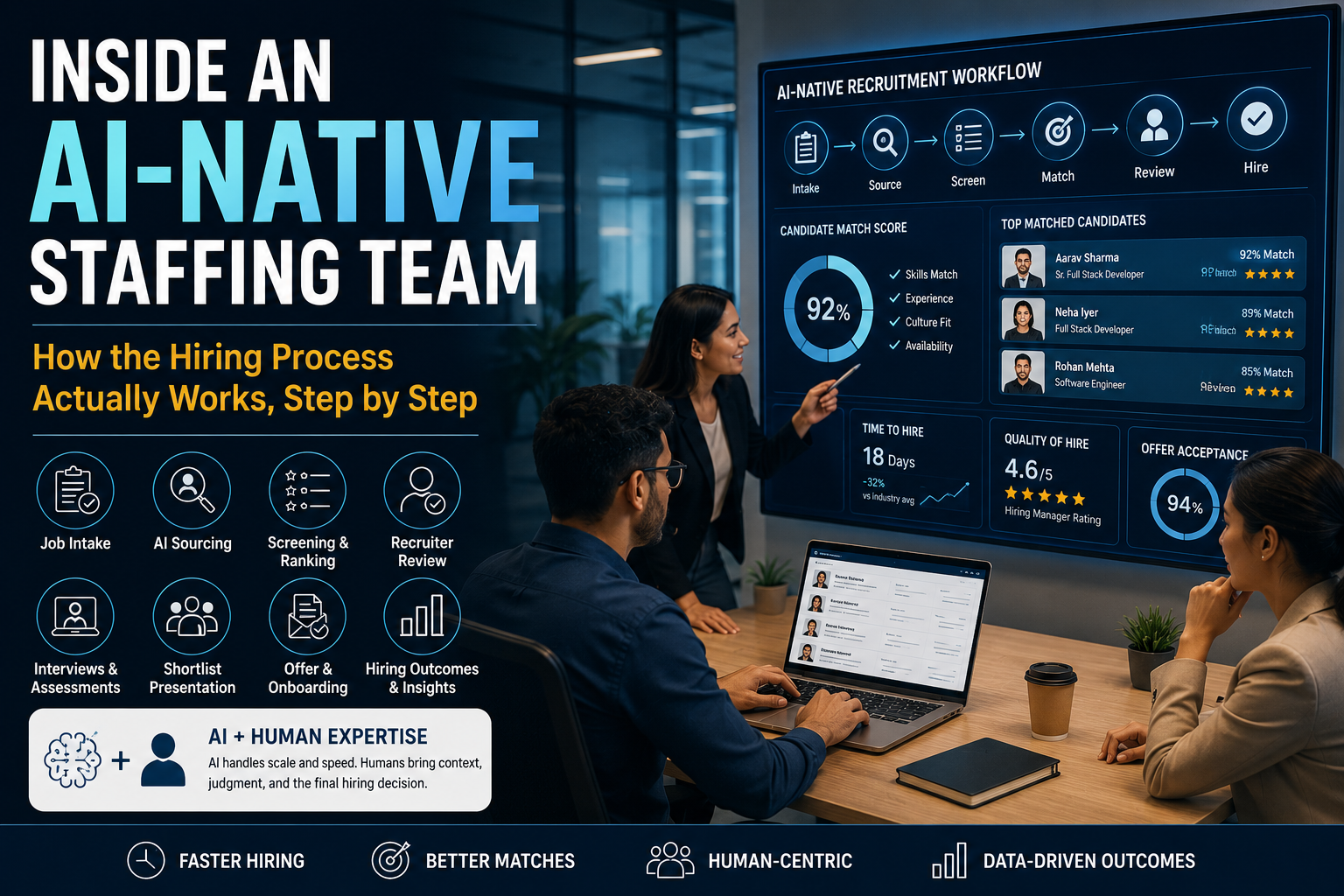
An AI-native staffing team combines artificial intelligence, recruitment automation, and human recruiter expertise throughout the hiring process—from understanding a job requirement and finding candidates to screening, matching, interviewing, making offers, and measuring hiring outcomes. AI handles data-intensive and repetitive work, while recruiters provide context, validation, candidate engagement, and human judgment.
That distinction is important.
An AI-native staffing team is not simply a traditional recruitment agency that has added ChatGPT, automated emails, or an AI resume-screening tool. AI is integrated into the underlying recruitment workflow and supports recruiters across multiple stages.
A typical process looks like this:
Job intake → AI-assisted sourcing → screening → candidate matching → recruiter validation → interviews and assessments → shortlist → offer and onboarding → post-hire measurement
The objective of AI Powered Recruitment is not to automate the final hiring decision. It is to help recruiters identify relevant candidates faster, reduce repetitive work, and spend more time evaluating and engaging the people most likely to fit the role.
An AI-native staffing team is a recruitment team that integrates AI into core activities such as job analysis, candidate discovery, screening, matching, communication, workflow automation, and recruitment analytics while retaining human recruiters for validation, candidate interaction, contextual evaluation, and hiring decisions.
The word native matters.
Consider three staffing models:
| Traditional Staffing | AI-Assisted Staffing | AI-Native Staffing |
|---|---|---|
| Primarily recruiter-driven | Traditional process plus individual AI tools | AI integrated across the recruitment workflow |
| Manual sourcing | AI may assist sourcing | AI-supported talent discovery and matching |
| Manual resume review | Automated resume screening | Multi-signal candidate analysis |
| Recruiter-created shortlist | AI recommendations | AI recommendations + recruiter validation |
| Basic reporting | Tool-specific analytics | Recruitment data used across the workflow |
| Human decision-making | Human decision-making | Human decision-making |
An agency does not become AI-native simply because recruiters occasionally use generative AI.
A genuine AI-native model redesigns the workflow around what technology can process efficiently and what humans can evaluate more effectively.
An AI-native staffing team typically moves through eight interconnected stages: job requirement intake, AI-assisted sourcing, screening and data enrichment, candidate matching and ranking, recruiter validation, interviews and assessments, offer management and onboarding, and post-hire measurement. Human oversight remains important throughout the process.
Here is the complete workflow at a glance.
| Stage | What AI/Automation Handles | What Human Recruiters Handle | Expected Output |
|---|---|---|---|
| 1. Job intake | Requirement extraction and structuring | Clarifying business needs | Search criteria |
| 2. Candidate sourcing | Large-scale discovery and search | Sourcing strategy and validation | Candidate pool |
| 3. Screening | Resume/skills analysis and filtering | Reviewing exceptions and context | Qualified candidate pool |
| 4. Matching | Candidate-role comparison and ranking | Validating recommendations | Prioritized candidates |
| 5. Recruiter validation | Workflow/data support | Candidate conversations and evaluation | Recruiter-approved shortlist |
| 6. Interviews & assessments | Scheduling, coordination and data organization | Interviews and contextual assessment | Interview results |
| 7. Offer & onboarding | Reminders and workflow automation | Negotiation and candidate engagement | Accepted hire |
| 8. Outcome measurement | Analytics and reporting | Interpreting results and improving strategy | Hiring insights |
Let’s examine what happens inside each stage.
The first stage is job intake, where the staffing team converts the employer’s hiring requirement into structured criteria that both recruiters and AI systems can use. This can include required skills, experience, seniority, location, compensation, availability, employment type, preferred qualifications, and business context.
A job description alone is rarely enough to understand a hiring requirement properly.
Imagine a SaaS company tells an AI Recruitment Agency:
“We need a senior backend developer with Python experience.”
A recruiter needs considerably more information.
Questions might include:
AI can help extract and structure these requirements, identify skills and organize search parameters.
The recruiter still needs to challenge unrealistic requirements and understand the business problem behind the vacancy.
Good candidate matching begins with accurate job intake. AI cannot compensate for a poorly defined hiring requirement.
AI recruitment agencies use technology to search, organize, and analyze large candidate pools based on job-relevant criteria such as skills, experience, job history, seniority, location, availability, and other permitted professional signals. Recruiters then validate the resulting talent pool and determine which candidates should be approached.
Traditional sourcing can involve recruiters manually searching profiles using combinations of titles and keywords.
AI-assisted sourcing can expand this process.
For example, a company might search for:
“Senior React Developer.”
A purely keyword-based search could overlook someone whose current title is:
“Senior Frontend Engineer”
even though the candidate has five years of React experience.
More sophisticated candidate discovery can analyze relationships among job titles, skills, experience and career history rather than depending exclusively on exact keyword matches.
AI-powered sourcing can also help recruiters organize searches across different candidate populations.
Active candidates are already searching or applying for jobs.
Passive candidates may be employed and not actively applying but could still be relevant to an opportunity.
Identifying candidates is only part of the job. Human recruiters remain important for deciding whom to approach and communicating the opportunity in a relevant way.
AI-assisted candidate matching compares job requirements with job-relevant candidate information to identify potentially suitable candidates. Depending on the system, this can include skills, experience, seniority, project history, industry background, location, availability, and preferences. Rankings should support recruiter review rather than automatically determine who gets hired.
This stage can involve three related processes.
Screening identifies whether candidates satisfy basic requirements.
For example:
Required: Python + Django + 5 years’ experience + Bengaluru/remote availability.
Candidates who clearly do not meet essential requirements can be separated from those requiring closer evaluation.
Matching asks a deeper question:
How closely does this candidate’s experience align with this particular role?
The system might examine:
Relevant candidates can then be prioritized for recruiter review.
A ranking should not be treated as an automatic hiring verdict.
A candidate ranked fifth by an algorithm may be the recruiter’s preferred candidate after a conversation reveals relevant experience that was not captured in the available profile.
AI candidate ranking should prioritize recruiter attention—not replace recruiter judgment.
Human recruiters validate AI recommendations, understand candidate motivations, evaluate contextual information, communicate with candidates, challenge questionable matches, coordinate with hiring managers, and oversee the recruitment process. AI can support decisions, but consequential hiring decisions should retain meaningful human oversight.
This is one of the biggest misconceptions about AI in Hiring.
AI-native does not mean recruiter-free.
After technology identifies promising candidates, recruiters can validate factors that are difficult to determine from structured profile data alone.
For example:
Human oversight is also important for responsible AI use.
The NIST AI Risk Management Framework provides a broader framework for managing risks associated with AI systems and emphasizes characteristics such as reliability, transparency, explainability, privacy, and fairness. NIST describes its framework as voluntary and designed to help organizations incorporate trustworthiness considerations into AI design, deployment, use, and evaluation.
In recruitment, this reinforces an important principle:
Automation should assist the hiring process without turning an algorithmic recommendation into an unquestioned employment decision.
Recruiter validation is the quality-control stage between AI-generated candidate recommendations and the employer’s shortlist. Recruiters verify relevant experience, candidate interest, availability, compensation expectations, communication, and other job-related requirements before deciding whether a candidate should be presented.
This stage prevents a common recruitment problem:
A high volume of apparently relevant resumes but very few genuinely interview-ready candidates.
Suppose AI identifies 50 potentially relevant engineers from thousands of profiles.
The recruitment team might prioritize 15 for deeper review.
After recruiter conversations, perhaps eight candidates meet the complete requirement and are genuinely interested.
Those eight—not all 50—should form the meaningful candidate pipeline.
An effective AI Talent Agency therefore does not measure sourcing success simply by the number of profiles generated.
Candidate relevance matters more than candidate volume.
An AI-native workflow can automate interview scheduling, reminders, assessment coordination, candidate status updates, and feedback organization. Recruiters and hiring managers remain responsible for evaluating candidates, interpreting assessment results, resolving conflicting feedback, and determining who should progress through the hiring process.
Automation is particularly useful for administrative coordination.
For example, it can assist with:
Candidate selected → calendar availability checked → interview scheduled → reminder sent → feedback requested → candidate status updated
Technical assessments can also be integrated into the workflow where appropriate.
A software engineering process might include:
Assessment results can become another input for candidate evaluation rather than being treated as the sole hiring decision.
Recruiters can also consolidate interview feedback so hiring managers can compare candidates more consistently.
AI-native staffing can reduce time-to-hire by accelerating candidate discovery, initial screening, matching, scheduling, communication, and recruitment administration. Candidate quality can improve when recruiters use those efficiencies to focus more attention on validating relevant candidates rather than spending most of their time on repetitive sourcing and coordination.
Consider a recruiter with 500 potential profiles.
In a traditional workflow, significant time may be spent manually reviewing profiles before meaningful candidate conversations even begin.
An AI-assisted workflow can prioritize candidates using predefined job criteria.
The recruiter can then focus more quickly on the strongest potential matches.
That can improve time-to-source and time-to-shortlist.
However, speed should not be optimized independently from quality.
Sending ten poorly matched candidates tomorrow is not necessarily better than sending five highly relevant candidates in three days.
Useful metrics include:
| Metric | What It Measures |
|---|---|
| Time-to-source | Time required to identify relevant candidates |
| Time-to-shortlist | Time from requirement to qualified shortlist |
| Time-to-hire | Time from hiring requirement to successful hire |
| Shortlist-to-interview rate | Relevance of submitted candidates |
| Interview-to-hire ratio | How efficiently interviews produce hires |
| Offer acceptance rate | Percentage of offers candidates accept |
| Candidate quality | How well candidates satisfy hiring requirements |
| Retention | Whether successful hires remain with the organization |
| Hiring-manager satisfaction | Employer assessment of candidate/hire quality |
AI is valuable when it improves these outcomes—not merely when it automates more activities.
Consider a technology company that needs a senior full-stack developer.
The requirement is:
AI structures the technical and logistical requirements while the recruiter confirms which criteria are mandatory.
The sourcing system searches for candidates whose profiles indicate relevant React, Node.js, cloud and software development experience.
It may identify candidates with related titles such as “Full-Stack Engineer,” “Senior Software Engineer” or “Lead Web Developer.”
Candidates are compared against the role requirements.
A developer with eight years of experience but no meaningful Node.js background might rank below someone with six years of directly relevant full-stack experience.
Recruiters examine the strongest matches and check whether the recommendations make sense.
Recruiters contact selected candidates and validate interest, availability, compensation expectations and relevant experience.
Qualified candidates complete the employer’s technical evaluation and interviews.
Automation can manage scheduling and status tracking.
Recruiters organize candidate information and interview feedback while the employer makes the final selection.
The recruiter coordinates expectations between the employer and candidate until the offer is accepted and onboarding begins.
This example illustrates the core principle of AI-native staffing:
AI narrows and organizes the search; humans validate and manage the relationship.
Businesses evaluating technology-driven recruiting approaches can also explore how Ellow approaches AI-enabled technology talent acquisition.
After candidate selection, the staffing team typically coordinates compensation discussions, offer communication, notice periods, documentation, joining dates, onboarding handoffs, and candidate follow-ups. After the employee joins, recruitment outcomes can be measured to determine whether the sourcing and matching process produced a successful hire.
Recruitment does not necessarily end when the hiring manager says, “We want this candidate.”
Offers can fail because of:
Human recruiters are particularly valuable here.
They can keep both sides informed, understand concerns and help prevent avoidable communication breakdowns.
Automation can support the process through reminders, documentation workflows and status tracking.
AI-native staffing teams can use recruitment data to evaluate whether the process produced efficient and successful hires. Post-hire measurement may include time-to-hire, conversion rates, offer acceptance, hiring-manager satisfaction, retention, and—where reliable data is available—longer-term quality-of-hire indicators.
This creates a feedback loop:
Requirement → candidates → interviews → hire → outcome → improved future recruitment
For example, if candidates with certain experience repeatedly progress through interviews while others are consistently rejected, recruiters can investigate whether the original sourcing criteria need refinement.
Likewise, a high candidate volume combined with a low interview rate may indicate poor matching or insufficient recruiter validation.
AI-native recruitment should therefore be viewed as an iterative process rather than a one-time automation pipeline.
An agency using AI tools adds individual technologies to an existing recruitment workflow. An AI-native staffing team integrates technology, data, automation, and recruiter actions across the hiring lifecycle so information from one stage can inform subsequent sourcing, matching, engagement, and measurement.
For example, a traditional agency might use:
Each tool solves an isolated problem.
An AI-native approach aims to connect the workflow.
The distinction is not about having more software.
AI-native recruitment is about designing the recruitment process so technology and human expertise complement each other from intake through hiring outcomes.
An AI-native recruitment agency generally works through the following process:
AI contributes speed, scale, pattern recognition and workflow efficiency.
Human recruiters contribute context, validation, communication, judgment and accountability.
The strongest process uses both.
An AI-native staffing team does not replace recruiters with algorithms.
It changes where recruiters spend their time.
Instead of manually searching hundreds or thousands of profiles, updating spreadsheets, sending repetitive reminders and coordinating every administrative step, recruiters can use technology to reduce repetitive work.
That creates more time for activities where human involvement matters most:
understanding hiring requirements, evaluating candidates, building relationships, advising hiring managers, managing offers and making contextual judgments.
The result should not simply be “more automated recruitment.”
The goal is a recruitment process capable of identifying relevant candidates efficiently while maintaining meaningful human oversight.
For employers comparing an AI Recruitment Agency with traditional staffing providers, the most useful question is therefore not:
“How much of your recruitment process is automated?”
A better question is:
“Where does AI improve the process, where do recruiters intervene, and how do you prove that the combination produces better hiring outcomes?”
AI can support candidate screening, matching and prioritization, but organizations should maintain appropriate human oversight for consequential employment decisions. Recruiters and hiring managers should evaluate the context behind algorithmic recommendations rather than automatically accepting rankings.
That depends on the system and employer’s workflow. A responsible recruitment process should define how automated screening is used, which criteria affect candidate progression, and where human review is required, particularly when automated decisions could incorrectly exclude qualified applicants.
AI-assisted sourcing can analyze available professional information to identify people whose skills, experience and career history align with a role even when they have not directly applied. Recruiters can then determine whether those individuals are appropriate to approach.
AI systems are typically used for data-intensive tasks such as searching candidate pools, extracting skills, comparing profiles, prioritizing matches and automating workflows. Human recruiters handle contextual evaluation, candidate conversations, relationship management, exceptions, negotiation and hiring strategy.
There is no universal timeframe. It depends on role complexity, talent availability, geography, compensation, hiring criteria and the level of candidate validation required. AI can accelerate discovery and initial screening, but a fast shortlist is valuable only when the candidates are genuinely relevant.
Businesses can track time-to-source, time-to-shortlist, time-to-hire, shortlist-to-interview rate, interview-to-hire ratio, offer acceptance rate, candidate quality, hiring-manager satisfaction and retention. These metrics reveal whether automation is contributing to actual hiring outcomes rather than simply increasing activity.
No. AI-assisted recruitment workflows can be applied across many industries and job categories. Their effectiveness depends on the quality of available data, the nature of the role, the recruitment system being used and the level of appropriate human oversight.

How AI-Powered Hiring Platforms Are Replacing Traditional Recruitment

India's Tech Talent Boom: Why Smart Companies Are Hiring There Now

Why Startups Fail at Tech Hiring (And How to Avoid It)
Please feel free to share your thoughts and we can discuss it over a cup of tea.
Get a quote
Software Development Outsourcing Challenges and how to solve them
Best database for web development: A developers guide

How AI-Native Agencies Find Passive Candidates Traditional Recruiters Miss
