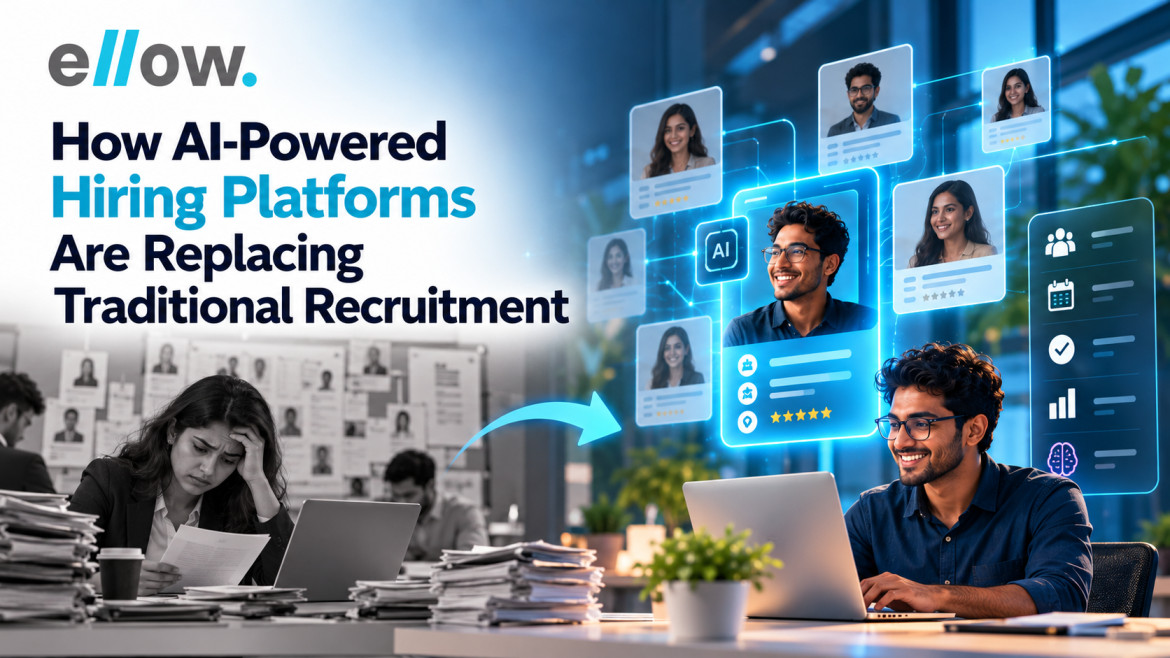
Recruitment has traditionally depended on job postings, recruiter networks, resume screening, phone calls, and multiple interview rounds. While these methods remain useful, they can become time-consuming when companies need to hire specialised professionals or manage a large volume of applications.
Finding the right candidate is not always straightforward. A qualified software engineer may not be actively looking for a new job. An experienced candidate’s resume may not contain the exact keywords listed in a job description. Recruiters may also spend hours reviewing applications that do not meet the role’s essential requirements.
AI-powered hiring platforms are changing how companies approach these challenges. By using artificial intelligence to support candidate discovery, profile analysis, communication, and recruitment workflows, these platforms can help hiring teams work more efficiently.
This shift has created opportunities for businesses to explore an AI Talent Agency or other technology-enabled recruitment solutions when traditional hiring methods are not delivering the desired results.
However, AI is not eliminating the need for recruiters. Instead, it is changing how recruitment work is performed, allowing technology to support repetitive tasks while people focus on candidate relationships, assessment, and final hiring decisions.
1. Why Traditional Recruitment Is Becoming More Challenging
Traditional recruitment processes were designed around human-led sourcing and evaluation. Recruiters publish job advertisements, search professional networks, review resumes, contact candidates, and coordinate interviews.
These activities remain important, but several challenges can limit their effectiveness.
Heavy dependence on manual resume screening
Recruiters may receive hundreds of applications for a single technical position. Reviewing each resume manually takes time, particularly when candidates have different job titles, educational backgrounds, or ways of describing similar skills.
A keyword-based approach can also overlook candidates who possess the required capabilities but use different terminology in their profiles.
Limited access to passive candidates
Many experienced professionals are already employed and are not actively applying for jobs. Companies that depend exclusively on job advertisements may miss candidates who could be interested in the right opportunity.
Slow recruitment workflows
Manual scheduling, follow-ups, application tracking, and coordination between hiring managers can delay decisions. Strong candidates may lose interest or accept competing offers while waiting for feedback.
Inconsistent candidate evaluation
When interviewers use different criteria, personal impressions can influence decisions. Without structured assessments, it becomes difficult to compare candidates fairly.
These challenges do not mean traditional recruitment is ineffective in every situation. They show why companies are increasingly combining established recruitment practices with modern technology.
2. What Are AI-Powered Hiring Platforms?
AI-powered hiring platforms use artificial intelligence and related technologies to support different stages of recruitment.
Depending on the product, these tools may help recruiters search for candidates, organise applications, generate job descriptions, draft outreach messages, schedule interviews, or analyse recruitment data.
Some platforms focus on a single task, such as applicant tracking or candidate sourcing. Others connect multiple stages of the recruitment process in one system.
For example, LinkedIn Recruiter offers AI-assisted search that allows recruiters to describe their requirements in natural language and receive candidate search results. Its tools can translate requests into structured search criteria and help recruiters explore potential matches.
Source: LinkedIn Recruiter — AI Search and Projects
How AI-powered recruitment differs
| Traditional recruitment | AI-powered recruitment |
|---|---|
| Often relies on manual candidate searches | Can assist with natural-language and skills-based searches |
| Recruiters manually review large volumes of profiles | Tools can help organise and prioritise profiles for review |
| Outreach messages are drafted individually | AI can assist with personalised message drafts |
| Recruitment data may be tracked across separate systems | Integrated platforms may centralise workflow information |
| Recruiters manually analyse process bottlenecks | Analytics can help identify delays and sourcing patterns |
These are general differences, not guarantees. Many traditional recruitment teams already use sophisticated software, and not every AI platform provides all the capabilities listed above.
The important distinction is how effectively a system supports the specific hiring requirements of a business.
3. AI Is Changing How Companies Find Candidates
Candidate sourcing is one of the areas where AI can make a practical difference.
Traditional searches often depend on job titles, exact keywords, Boolean strings, location filters, and years of experience. These methods can be useful, but they may miss candidates whose skills are relevant even when their profiles use different language.
AI-assisted search can help recruiters describe the candidate they need in ordinary language and identify potentially relevant profiles.
Example: Hiring a senior software engineer
Suppose a company wants to hire a senior backend engineer who has experience building scalable APIs, working with cloud infrastructure, and supporting high-traffic applications.
A conventional search might focus on terms such as “Senior Backend Developer,” “Java,” “AWS,” and “API development.”
An AI-assisted search may help recruiters express the broader requirements and explore candidates whose experience is described differently. Recruiters can then review the results, refine the search, and check whether the candidates genuinely meet the requirements.
This can be particularly useful when hiring for specialised positions, where relevant experience may appear under several different job titles.
An AI Recruitment Agency may be worth evaluating if a business needs help sourcing technical candidates and wants to understand how AI-assisted methods fit into its recruitment process.
The goal is not to let an algorithm decide who should be hired. It is to help recruiters discover relevant candidates more effectively.
4. AI-Powered Platforms Can Help Identify Passive Candidates
Passive candidates are professionals who are not actively searching for a new job but may consider a suitable opportunity.
These candidates can be important for companies hiring experienced engineers, technical leaders, data specialists, and other professionals whose skills are in demand.
Traditional recruitment teams often identify passive candidates through referrals, networking, professional platforms, and direct outreach. AI-enabled tools can support these activities by helping recruiters search larger candidate pools and identify relevant experience.
How AI-assisted sourcing can work
A recruitment team begins by defining the position, including the technical skills, responsibilities, experience, and location requirements.
The platform then helps identify candidate profiles that may match those criteria. Recruiters review the profiles, verify the information, and decide whom to contact.
For example, a candidate may not have the exact title “Machine Learning Engineer” but may have worked on model deployment, data pipelines, and production AI systems. A broader search may help a recruiter discover this potentially relevant experience.
However, profile information is not always complete or current. Candidates may have changed roles, developed new skills, or listed experience that requires further verification.
AI can support discovery, but recruiters still need to confirm suitability through conversations, assessments, and relevant evidence.
5. Automated Screening Can Reduce Repetitive Work
Initial screening is another stage where recruitment teams may spend significant time.
Recruiters often need to check whether applicants meet essential requirements, such as relevant technical experience, professional qualifications where necessary, location restrictions, or specific project experience.
AI-enabled tools can help organise application information and highlight details for recruiters to review.
What automated screening can support
- Extracting relevant information from resumes.
- Organising candidate profiles against role requirements.
- Identifying missing information for follow-up.
- Helping recruiters prepare screening questions.
- Summarising relevant experience for human review.
These capabilities can reduce repetitive administrative work, but they should not be confused with reliable proof of competence.
A resume may contain inaccurate information, and a candidate who does not use familiar terminology may still possess the necessary skills. Screening criteria should therefore be relevant to the role and reviewed regularly.
For technical positions, structured interviews, practical assessments, and portfolio discussions remain valuable ways to evaluate what a candidate can actually do.
6. AI Can Make Candidate Communication More Efficient
Recruitment involves more than identifying suitable candidates. Recruiters also need to communicate with applicants, arrange interviews, provide updates, and answer questions.
When these activities are handled manually, candidates may experience delays or receive inconsistent information.
AI-enabled tools can assist with drafting outreach messages, preparing interview communications, and managing routine follow-ups.
Personalised outreach instead of generic messages
Consider a recruiter contacting a software engineer with experience in cloud migration and distributed systems.
A generic message might simply announce a vacancy and ask whether the candidate is interested.
A more relevant message could explain why the candidate’s experience appears connected to the role, describe the technical challenge involved, and provide a clear next step.
AI can help draft this type of message, but recruiters should verify that the candidate’s experience is described accurately and that the opportunity is represented honestly.
Personalisation should not become mass messaging with superficial changes to each candidate’s name. Relevant, respectful communication is more useful than sending a large volume of automated messages.
7. Recruitment Analytics Can Help Companies Improve Hiring Decisions
Many businesses measure recruitment performance through basic metrics such as the number of applications received or the time taken to fill a position.
These measures are useful, but they do not tell the complete story.
AI-enabled recruitment platforms and analytics tools may help companies understand where candidates are coming from, where they leave the process, and which recruitment stages create delays.
Important recruitment metrics to monitor
Time-to-hire: Measures the time taken to move a candidate through the relevant hiring stages, depending on the company’s definition.
Time-to-fill: Tracks the time between opening a vacancy and filling it.
Interview-to-offer rate: Shows how frequently interviewed candidates receive offers.
Offer acceptance rate: Measures the proportion of offers accepted.
Source of hire: Identifies which sourcing channels contribute to successful hires.
Quality of hire: Evaluates new-hire outcomes using suitable measures, such as performance, retention, and time to productivity.
These metrics should be interpreted together. A shorter hiring process is not necessarily better if it leads to unsuitable hires, and a high application volume does not automatically indicate effective recruitment.
The purpose of analytics is to help companies identify meaningful improvements rather than optimise a single number.
8. AI in Hiring Still Requires Human Oversight
Although AI can assist with recruitment, it introduces risks that companies must manage.
A system may produce inaccurate summaries, rely on incomplete information, or favour patterns found in historical recruitment data. If those patterns reflect past inequalities, automated recommendations may reinforce them.
There are also concerns involving candidate privacy, transparency, accessibility, and the use of personal information.
How businesses can use AI responsibly
Companies should begin by understanding what a platform actually does and which decisions it influences.
A responsible approach includes:
- Using clear, job-related evaluation criteria.
- Reviewing AI-generated recommendations before acting on them.
- Testing for unfair outcomes across candidate groups where appropriate and lawful.
- Protecting candidate information and limiting unnecessary data access.
- Providing reasonable opportunities for candidates to demonstrate their skills.
- Keeping humans accountable for important hiring decisions.
- Monitoring system performance and addressing errors.
Employers should also check the legal requirements that apply in the locations where they recruit.
AI should help make recruitment more effective and consistent, not introduce an opaque process that candidates and hiring teams cannot understand.
9. Will AI Replace Traditional Recruiters?
AI is changing recruitment, but a complete replacement of human recruiters is unlikely to be appropriate for many hiring situations.
Recruitment involves judgement, negotiation, relationship-building, understanding business needs, and evaluating how a person may contribute to a team. These responsibilities are particularly important for senior roles, leadership positions, specialised technical jobs, and situations where requirements are evolving.
AI is better understood as a set of tools that can support selected recruitment activities.
What AI can do well
- Assist with searching and organising candidate information.
- Support repetitive administrative tasks.
- Help draft job descriptions and outreach messages.
- Summarise information for further review.
- Provide data that helps recruiters understand process performance.
Where human expertise remains important
- Understanding the hiring manager’s actual needs.
- Building trust with candidates.
- Evaluating complex technical experience.
- Discussing compensation and expectations.
- Identifying gaps in available information.
- Making fair, evidence-based hiring decisions.
The most effective recruitment approach may combine automation with experienced recruiters who understand the business, the role, and the candidate market.
This is also why companies should evaluate an AI Talent Agency based on the value it provides, its actual capabilities, and the quality of its recruitment process—not simply whether it uses AI.
10. How to Choose an AI-Powered Recruitment Platform
Not every business needs a comprehensive AI recruitment system. A startup hiring a few employees each year may have different requirements from an enterprise recruiting hundreds of professionals across multiple locations.
Before selecting a platform or recruitment partner, companies should identify their main challenges.
Questions to ask before choosing a solution
What problem will it solve? Determine whether the main need is sourcing, screening, candidate communication, workflow management, or analytics.
Does it support the roles you hire for? A tool that works well for high-volume recruitment may not be appropriate for specialised engineering positions.
How are candidate matches generated? Understand the information used, how results are presented, and whether recruiters can review and adjust the criteria.
Can it integrate with existing systems? Check compatibility with the company’s applicant tracking system, HR software, and recruitment workflow.
How does it protect candidate information? Review data access, retention, security, and applicable privacy obligations.
Can its performance be evaluated? Define how the business will measure relevance, efficiency, candidate experience, and hiring outcomes.
Is human oversight supported? Recruiters should be able to review recommendations, correct errors, and retain responsibility for hiring decisions.
Businesses considering an AI Recruitment Agency should also confirm the provider’s services, pricing, technical recruitment experience, and reporting practices before making a decision.
11. A Practical Framework for Adopting AI in Recruitment
Companies do not need to automate every part of recruitment at once. A phased approach can help them understand where technology provides genuine value.
Step 1: Identify the biggest bottleneck
Review the current recruitment process. Is the team struggling to find suitable candidates, manage applications, schedule interviews, or analyse results?
Step 2: Establish a baseline
Record current performance using relevant metrics, such as time-to-hire, sourcing effectiveness, offer acceptance, and recruiter workload.
Step 3: Select a suitable tool
Choose technology that addresses the identified problem and meets the company’s security, privacy, and operational requirements.
Step 4: Run a controlled pilot
Test the tool on a defined set of roles. Compare the results with the existing process and collect feedback from recruiters and candidates where appropriate.
Step 5: Evaluate quality as well as speed
Check whether the tool helps identify relevant candidates, reduces unnecessary work, and maintains a fair candidate experience.
Step 6: Improve and expand carefully
Adjust the process based on the evidence. Expand usage only when the tool demonstrates meaningful value and its risks can be managed.
This approach helps businesses avoid adopting AI simply because it is popular. The objective is to improve recruitment outcomes in measurable ways.
Frequently Asked Questions
1. What is an AI-powered hiring platform?
An AI-powered hiring platform uses artificial intelligence to support recruitment activities such as candidate sourcing, application organisation, communication, screening support, and recruitment analytics. The specific capabilities vary by product.
2. How is AI-powered recruitment different from traditional recruitment?
Traditional recruitment often relies more heavily on manual searches, resume reviews, and administrative coordination. AI-powered recruitment can assist with these tasks, helping recruiters process information and explore candidate pools more efficiently. Human evaluation remains important.
3. Can AI recruitment platforms find better candidates?
AI-assisted search may help recruiters discover candidates whose skills are relevant even when their profiles do not contain exact keywords. However, search results are only potential matches. Recruiters must verify experience and evaluate candidates against the actual requirements of the role.
4. Is AI recruitment suitable for small businesses?
It can be, particularly when a business has repetitive recruitment tasks or difficulty identifying suitable candidates. Small businesses should compare the cost and complexity of a tool with the scale of their hiring needs.
5. Does AI remove bias from recruitment?
No. AI can reproduce or introduce bias depending on its design, data, and use. Employers should use job-related criteria, evaluate outcomes, protect candidate information, and maintain appropriate human oversight.
6. What is the role of an AI Recruitment Agency?
An AI Recruitment Agency may combine recruitment expertise with AI-enabled tools to support activities such as candidate sourcing, profile review, and workflow management. The exact services vary, so companies should verify the agency’s capabilities before engaging it.
Conclusion
AI-powered hiring platforms are changing recruitment by helping companies search for candidates, organise applications, support communication, and analyse hiring performance. These capabilities can reduce repetitive work and give recruiters more time to focus on candidate relationships and meaningful evaluation.
However, AI does not automatically produce better hiring decisions. Inaccurate information, unsuitable criteria, privacy risks, and biased outcomes can undermine the process if companies rely on automation without appropriate safeguards.
The strongest approach combines useful technology with clear hiring requirements, structured assessments, transparent communication, and human accountability.
For companies looking to modernise their recruitment process, an AI Talent Agency or an AI Recruitment Agency may be worth evaluating against specific hiring needs. The important question is not whether a provider uses AI, but whether its approach helps the business identify suitable candidates and make better-informed hiring decisions.
As recruitment technology continues to evolve, companies that adopt it thoughtfully will be better positioned to improve efficiency without losing the human judgement that successful hiring requires.