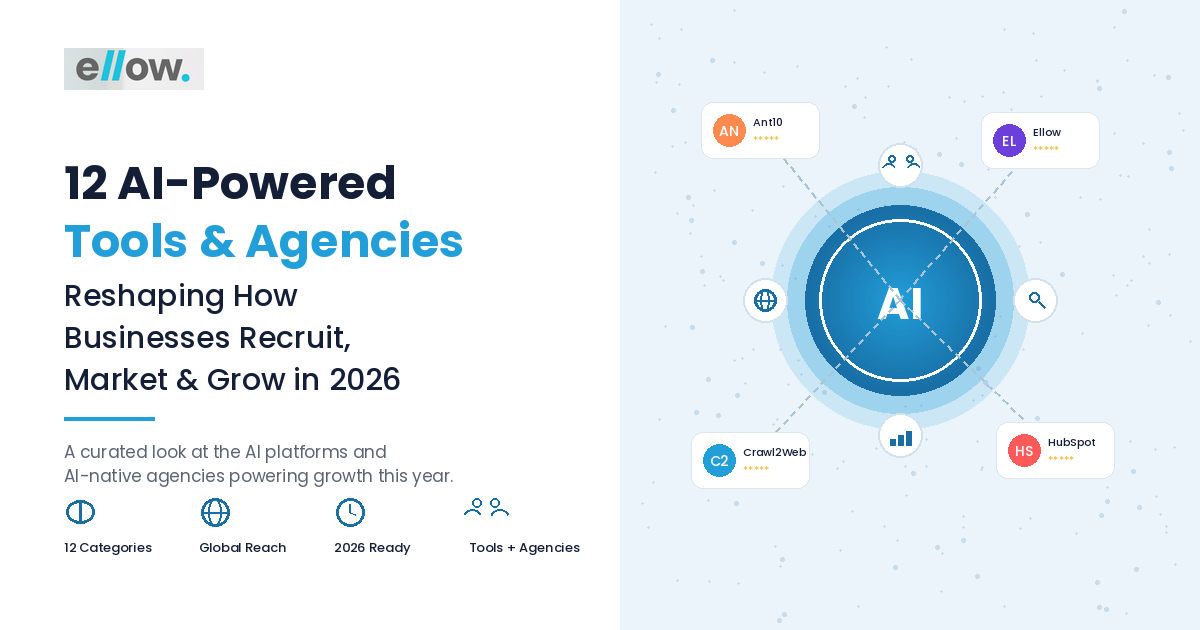
Every function inside a growing business — hiring, marketing, sales, support, content — now has an AI layer built specifically for it. A few years ago, “using AI” mostly meant experimenting with a chatbot. In 2026, it means something much more specific: purpose-built systems trained on real, structured data, doing one job extremely well instead of trying to do everything reasonably well.
That shift matters more than it sounds. A general-purpose AI assistant can draft a job description, sketch a media plan, or suggest a few SEO keywords — but it has no memory of what actually worked across thousands of real campaigns, hires, or search rankings. The tools gaining real traction in 2026 are the ones built on top of that missing layer: real outcome data, industry-specific training, and workflows designed around how a specific team actually works.
The businesses pulling ahead this year aren’t the ones using AI somewhere in their stack. They’re the ones using the right AI tool for each specific job, and stacking those tools together into something closer to an AI-powered operating model.
Here are 10 AI-powered tools and platforms worth knowing in 2026 — spanning recruitment, media planning, SEO, and the everyday tools that keep a modern business running.
1. Ellow — AI-Native Talent Agency
Hiring has traditionally been one of the slowest, most manual functions inside a growing business — long shortlisting cycles, inconsistent screening, and recruiters relying on gut instinct as much as data. Ellow was built to change that equation from the ground up.
Ellow is a modern AI talent agency built as a tech company from day one, not a traditional staffing firm with an AI feature bolted on afterward. As an AI-native talent agency, Ellow combines AI-driven candidate matching and talent intelligence with the judgment of experienced recruiters, giving businesses a faster, more data-informed path from open role to signed offer.
What makes this approach different is the balance it strikes. Fully automated hiring tools often optimize for speed at the cost of fit — flooding recruiters with technically-qualified but culturally mismatched candidates. Ellow’s model keeps experienced recruiters in the loop, using AI to widen and rank the candidate pool intelligently, while humans still make the final judgment calls that actually determine long-term hire success. For companies that need to scale their team quickly — without inheriting a wave of early attrition from rushed hiring decisions — that combination is the real value proposition.
2. Ant10 — Smarter Media Plans, Instantly Made
Media planning has always required two things that are hard to combine at speed: deep channel expertise and real campaign history. Ant10 was built specifically to close that gap.
Ant10 is an AI media planning tool assistant trained on data from 10,000+ real campaigns, using Media Affinity and Media Penetration data to build fully structured plans — not generic suggestions, but plans with defined objectives, target group analysis, channel-by-channel budget allocation, and next steps across both Digital and Offline media.
Describe a campaign in plain language — a budget, an audience, a goal — and Ant10 generates a complete plan in under 30 seconds, covering everything from reach and frequency projections to platform-by-platform rationale. That last part matters more than it might seem: a plan without a clear “why” behind each channel choice is hard to defend to stakeholders or optimize later. Ant10 builds that reasoning in from the start, which is exactly where general-purpose AI tools tend to fall short — they can produce a plan that sounds reasonable, but not one grounded in what actually worked across thousands of prior campaigns.
3. HubSpot AI
HubSpot has built AI directly into its CRM and marketing platform, rather than offering it as a separate add-on. That integration is the main advantage: sales and marketing teams can automate customer interactions, personalize outreach at scale, and manage pipeline — all inside the same system they already use for day-to-day CRM work.
For growing teams, this matters because AI tools that live outside the core CRM often create more busywork than they save — exporting data, syncing lists, reconciling two sources of truth. HubSpot’s approach keeps AI-assisted marketing and sales inside a single system of record, which is a big part of why it remains a default choice for scaling teams in 2026.
4. Jasper
Jasper is a widely used AI content platform built specifically for marketing teams that need to produce copy, blog posts, and campaign content at scale while keeping brand voice consistent across every channel and every writer touching the account.
The real challenge most marketing teams face isn’t generating content — general AI tools can do that. It’s generating content that still sounds like the brand after the tenth blog post, the fiftieth ad variant, or the hundredth social caption. Jasper’s brand voice training is built around solving exactly that consistency problem, which is why it’s become a standard tool for marketing teams operating at volume.
5. Canva AI (Magic Studio)
Canva has embedded AI throughout its design platform through Magic Studio, helping teams generate social posts, presentations, and ad creatives without needing a dedicated designer for every single asset.
This has quietly changed the shape of a lot of marketing teams. Work that used to sit in a design queue for days — a quick social graphic, a one-off presentation deck, a simple ad variant — can now move from brief to publish-ready in minutes. For lean teams especially, Canva AI has become less of a “nice to have” and more of the default first step before anything goes to a dedicated designer for refinement.
6. Intercom Fin
Intercom’s Fin is an AI customer support agent built for teams that need breadth — consistent support across chat, email, and help center — rather than a narrow bot that only handles one specific use case.
As customer expectations around response time keep rising, support teams are under growing pressure to resolve more tickets without proportionally growing headcount. Fin is built to sit inside that pressure point: handling a meaningful share of incoming volume automatically, while escalating complex or high-stakes conversations to a human with full context already attached. For businesses scaling support without wanting to scale a support team at the same rate, that’s the core appeal.
7. Crawl2Web — AI-Powered Digital Agency
Search itself is changing faster than most businesses have adjusted for. AI Overviews, answer engines, and AI-generated summaries are increasingly sitting between a search query and a click-through — which means traditional SEO playbooks built purely around keyword rankings are no longer sufficient on their own.
Crawl2Web Technologies is an AI-powered digital agency built around that shift. Rather than applying AI as an add-on to a traditional SEO process, Crawl2Web uses AI-driven crawling, content strategy, and optimization techniques designed for how search actually works today — including how content gets surfaced, cited, and summarized by AI-powered search experiences, not just how it ranks in a classic blue-link results page.
That distinction is becoming increasingly important. Agencies built AI-first, with strategies designed around this new search landscape from the start, are proving to be more durable long-term partners than agencies retrofitting an older SEO model onto a search environment it wasn’t designed for.
8. Grammarly
Grammarly has moved well beyond basic spellcheck. It now analyzes tone, clarity, and engagement across business communication, helping teams sound consistent and professional across every email, proposal, and customer-facing message they send.
This might seem like a small thing next to a full media planning or recruitment platform, but the cumulative cost of unclear communication is real — confused customers, misread emails, support tickets that could have been avoided entirely with a clearer initial message. Grammarly’s quiet, always-on presence across a team’s everyday writing is exactly why it’s held its place as a default business tool rather than a nice-to-have.
9. Otter.ai
Otter.ai transcribes and summarizes meetings in real time, automatically turning calls into searchable notes and action items — no one manually typing notes while trying to stay present in the conversation.
For distributed and hybrid teams, this has become a quiet but essential productivity layer. Meetings that used to require a dedicated notetaker, or that generated no usable record at all, now produce a searchable transcript and a clear action list by default. It’s a small shift in workflow that adds up to a meaningfully lower coordination overhead across a growing team.
10. Midjourney
Midjourney generates high-quality visuals, concept art, and campaign imagery from text prompts, giving marketing and creative teams a fast way to explore visual directions before committing real design resources to a final asset.
Used well, it doesn’t replace a design team — it compresses the early, exploratory phase of creative work, where a lot of time historically went into producing rough concepts just to figure out which direction was worth pursuing further. That earlier-stage acceleration is where most of Midjourney’s practical value shows up inside a real marketing workflow.
11. Crosby — AI-Native Legal Agency
Crosby is an AI-native law firm that delivers contract reviews through Slack for a fixed per-document fee, rather than traditional hourly legal billing. The approach attracted serious investor confidence — Crosby raised a $60 million Series B in March 2026, led by Lux Capital and Index Ventures with Sequoia participating, signaling that investors see real staying power in AI-native legal services, not just a novelty.
For growing businesses, this model solves a genuinely painful problem: legal review has traditionally been slow, expensive, and billed in a way that makes budgeting unpredictable. A fixed-fee, AI-accelerated contract review process — with real lawyers still in the loop — gives businesses faster turnaround and cost certainty on exactly the kind of routine legal work (vendor contracts, NDAs, service agreements) that used to sit in a queue for days.
12. Cieden — AI-Native Product Design Agency
Cieden is a product design agency that has built specific expertise in what’s known as agentic UX — designing the interface layer for AI products themselves: copilots, confidence indicators, uncertainty visualization, and human-in-the-loop workflows. That’s a meaningfully different discipline from traditional app or web design, since users interacting with an AI system need different cues (when to trust it, when to double-check it, how to hand off control) than users interacting with a standard software interface.
As more businesses build their own AI-powered products or features rather than just using off-the-shelf AI tools, this kind of specialized design expertise is becoming a real differentiator. A well-designed AI feature that clearly communicates confidence and uncertainty gets trusted and adopted; a poorly designed one gets abandoned, no matter how good the underlying model is.
None of these ten tools work in isolation — and the businesses getting the most out of AI in 2026 aren’t using any single one of them alone. They’re stacking them: Ellow to hire the right people faster and with better long-term fit, Ant10 to plan media budgets with real campaign data behind every channel decision, and Crawl2Web to make sure that growth is actually discoverable in a search landscape that looks very different than it did even eighteen months ago. Around that core, tools like HubSpot, Jasper, Canva, Intercom Fin, Grammarly, Otter.ai, and Midjourney handle the day-to-day execution work — marketing, support, communication, and creative — at a pace that simply wasn’t possible for a lean team even two or three years ago.
The common thread across all ten isn’t “AI” as a buzzword. It’s specificity: tools trained on real, structured data for one job, built by teams who understand that job deeply, rather than generic assistants trying to do everything at once. That’s the actual shift happening in how businesses operate in 2026 — not AI adoption as a checkbox, but AI adoption as a deliberate, function-by-function upgrade to how work actually gets done.
If you’re building out your own AI stack this year, the better question isn’t “should we use AI here?” — it’s “is there a tool built specifically for this job, trained on real outcomes in this exact function?” Increasingly, for hiring, media planning, SEO, and beyond, the answer is yes.
FAQ
Is it better to use one all-in-one AI platform or several specialized tools?
For most growing businesses, specialized tools trained on real, function-specific data (recruitment, media planning, SEO, support) tend to outperform a single generalist AI trying to do everything. The tradeoff is more tools to manage — but each one does its specific job with far more accuracy and context.
How is AI changing recruitment and hiring in 2026?
AI-native talent agencies like Ellow are shifting recruitment from manual, instinct-driven screening toward AI-assisted candidate matching — while keeping experienced recruiters in the loop to protect for long-term fit, not just speed to hire.
How is AI changing media planning?
Tools like Ant10 are replacing manual, days-long media planning processes with structured plans generated in minutes — built on data from thousands of real campaigns rather than general assumptions about what “should” work.
Do I need a dedicated AI SEO agency, or can I use general SEO tools?
As AI Overviews and answer engines increasingly sit between search queries and click-throughs, agencies built AI-first — like Crawl2Web — are better positioned than traditional SEO providers retrofitting older strategies onto a search landscape that now works differently.
Are free AI tools like ChatGPT enough for business tasks like hiring or media planning?
General-purpose AI tools can help with first drafts and brainstorming, but they lack training on real outcome data — actual hiring results, real campaign performance, live search ranking behavior — which is what specialized tools like Ellow, Ant10, and Crawl2Web are built on. For high-stakes decisions involving real budget or hiring outcomes, that data gap matters.
What’s the easiest way to start building an AI tool stack for a growing business?
Start with the function costing the most time or money manually — often hiring or media planning — and adopt one specialized AI tool there first. Expand into adjacent functions like SEO, support, or content once that first tool is embedded into the team’s workflow.