Let’s buildthe future together.
Great ideas need great people. Partner with us to bring your vision to life, or take the first step in your career by joining our team of innovators.



Receive new articles delivered Straight to your inbox
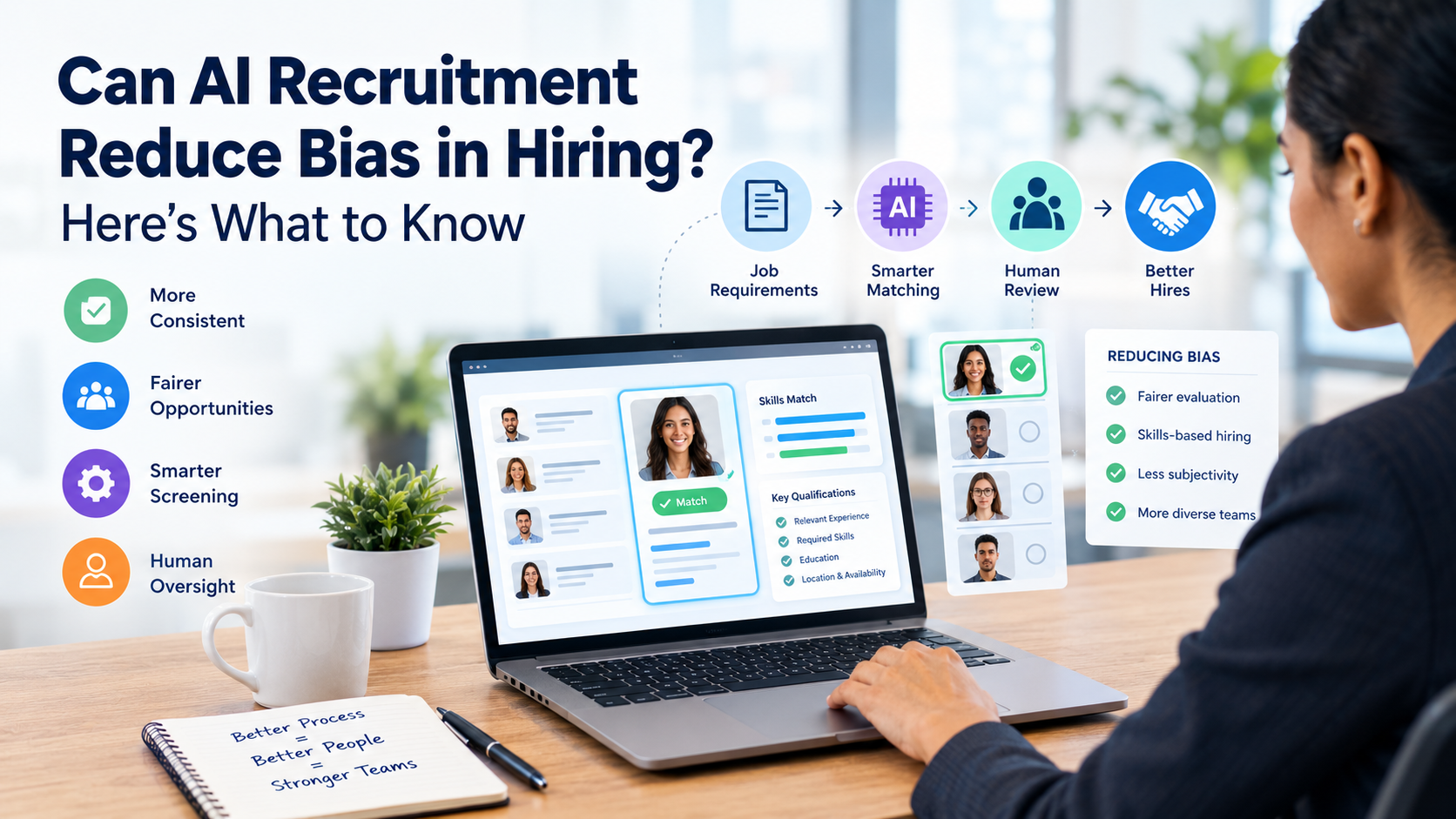
Yes, AI recruitment can potentially reduce certain forms of hiring bias by applying more consistent evaluation criteria, supporting skills-based matching, and reducing some subjective judgments during early-stage screening. However, AI does not automatically make recruitment fair or unbiased. AI systems can reproduce or amplify bias when their data, criteria, design, or implementation are flawed.
That distinction is essential for businesses adopting AI in Hiring.
Human recruiters can be influenced—consciously or unconsciously—by factors unrelated to a person’s ability to perform a job. AI-assisted recruitment can help standardize parts of candidate evaluation, but algorithms introduce their own risks. Historical hiring patterns, unrepresentative datasets, proxy variables, inappropriate scoring criteria, and insufficient human oversight can all produce unfair outcomes.
The most responsible approach is therefore neither “humans only” nor “AI decides.”
It is a combination of structured technology, job-relevant evaluation criteria, bias testing, transparency, data governance, ongoing monitoring, and meaningful human oversight.
AI bias in recruitment occurs when an automated or AI-assisted hiring system systematically produces unfair or unjustified differences in how candidates are evaluated, ranked, recommended, or filtered. Bias can originate from training data, model design, candidate data, evaluation criteria, proxy variables, or how employers use the system’s outputs.
Algorithmic bias does not necessarily mean someone intentionally designed a discriminatory system.
A model can generate problematic outcomes even when developers did not explicitly include protected characteristics in candidate scoring.
For example, historical patterns embedded in training data can influence future recommendations. Seemingly neutral information can also correlate with demographic characteristics and act as a proxy.
This is why fairness requires more than simply removing a candidate’s name, age, gender, or photograph.
AI can reduce some forms of hiring bias when candidates are assessed consistently against carefully designed, job-relevant criteria. However, AI cannot eliminate bias from recruitment. Poor training data, inappropriate criteria, proxy variables, model design, and overreliance on automated scores can introduce new biases or reproduce existing inequalities.
The best way to understand the issue is to separate two questions:
Can AI reduce some human subjectivity?
Yes, potentially.
Does using AI guarantee unbiased hiring?
No.
Imagine that 500 people apply for a software engineering position.
A human recruiter manually reviewing resumes may unintentionally give additional attention to candidates who attended familiar universities, worked for recognizable companies, have similar backgrounds, or present their experience in a personally familiar way.
A properly designed skills-based system could instead consistently prioritize job-relevant criteria such as:
That could reduce certain subjective influences.
But suppose the algorithm was trained primarily on historical employees from one demographic group.
The system could learn patterns associated with past hiring decisions and reproduce them.
AI can change where bias enters recruitment; it does not automatically remove bias from the process.
Structured AI-assisted recruitment can potentially reduce affinity bias, inconsistent screening, educational-prestige bias, confirmation bias, and some forms of unconscious bias by applying the same predefined, job-relevant criteria across candidates. The benefit depends on whether those criteria themselves are appropriate and fairly designed.
Several forms of human bias can affect recruitment.
Affinity bias occurs when people favor candidates who seem similar to themselves.
A recruiter or manager might unconsciously feel more comfortable with someone who attended the same university, shares similar interests, comes from a familiar company, or has a comparable background.
Skills-based candidate matching can reduce reliance on these similarities when they are irrelevant to job performance.
Confirmation bias occurs when someone forms an early opinion and then pays greater attention to evidence supporting that opinion.
For example, after seeing a prestigious employer on a resume, an interviewer might interpret later information more positively.
Structured evaluation criteria can help hiring teams assess candidates across the same predefined dimensions.
Employers sometimes use university reputation as a shortcut for candidate quality even when educational prestige has limited relevance to the actual job.
A skills-focused recruitment system can potentially give greater weight to demonstrated capabilities and relevant professional experience.
Human decision-makers can consciously or unconsciously react to names, photographs, age, gender, race, ethnicity, disability, or other demographic information.
Technology can sometimes limit the influence of unnecessary information during particular stages of recruitment.
However, hiding demographic fields alone does not guarantee fairness because other data can act as proxies.
One candidate may be evaluated strictly while another receives a more flexible assessment.
Standardized evaluation criteria can improve consistency by asking:
Does each candidate satisfy the same job-relevant requirements?
Consistency is one area where thoughtfully implemented AI Powered Recruitment can provide useful decision support.
AI-assisted recruitment can improve consistency by converting job requirements into structured criteria and applying those criteria across a candidate pool. Systems may compare candidates based on relevant skills, experience, qualifications, seniority, or other job-related factors while recruiters review recommendations and investigate important contextual information.
Consider a cybersecurity position requiring:
A structured system can search for those requirements across the candidate pool instead of allowing each resume to be evaluated according to changing subjective standards.
The system could help answer:
This can create greater consistency.
But consistent application of bad criteria is still bad recruitment.
If an employer unnecessarily requires ten years of experience for a role that realistically needs five, automation could simply enforce that flawed requirement more efficiently.
Technology does not eliminate the need to design good hiring criteria.
Human and algorithmic bias can arise differently, which means they also require different mitigation strategies.
| Type | Potential Source of Bias | Example | Possible Mitigation |
|---|---|---|---|
| Human bias | Personal similarity | Preferring candidates with familiar backgrounds | Structured evaluation |
| Human bias | First impressions | Forming an opinion before assessing evidence | Standardized interviews |
| Human bias | Educational prestige | Favoring specific universities | Skills-based criteria |
| Human bias | Stereotypes | Assumptions based on demographic characteristics | Training + structured processes |
| AI bias | Historical data | Learning patterns from previous biased decisions | Data review and bias testing |
| AI bias | Unrepresentative data | Some groups poorly represented | Improve dataset quality |
| AI bias | Proxy variables | Neutral-looking data correlates with protected characteristics | Feature analysis and audits |
| AI bias | Poor criteria | Ranking candidates using irrelevant signals | Job-relevance validation |
| AI bias | Automation dependence | Recruiters blindly following scores | Meaningful human review |
The key takeaway is straightforward:
Human bias and algorithmic bias are different problems, but neither disappears simply because technology is introduced.
Yes. AI recruitment algorithms can introduce, reproduce, or amplify bias when they learn from biased historical data, use unrepresentative datasets, rely on inappropriate candidate attributes or proxies, optimize for flawed historical outcomes, or operate without adequate testing and human oversight.
Consider a hypothetical company where past hiring overwhelmingly favored one type of candidate.
If an AI model is trained to identify candidates who resemble historically successful hires without carefully examining why those candidates were selected, it may learn patterns associated with the company’s past rather than characteristics genuinely necessary for future job performance.
The result could be systematic disadvantage for otherwise qualified candidates.
Another risk is scale.
A biased human decision might affect several applicants.
A biased automated system applied to thousands of applications could reproduce the same problematic pattern much more widely.
Automation can scale good processes, but it can also scale flawed processes.
Bias in AI hiring systems can originate from historical hiring data, unrepresentative training datasets, biased labels, inappropriate evaluation criteria, proxy variables, incomplete candidate information, model objectives, or human decisions about how algorithmic outputs are interpreted and used.
Historical data reflects decisions made in the real world.
If previous recruitment contained systematic inequalities, using those decisions as examples of “successful hiring” can transfer those patterns into an AI model.
A model trained on data that poorly represents the population where it will be used may perform differently across groups.
Suppose an algorithm is designed to identify candidates similar to employees who were previously promoted.
That sounds reasonable.
But if historical promotion decisions were themselves influenced by unequal opportunities, the model may learn those historical patterns rather than objective indicators of job performance.
Removing obvious demographic information does not necessarily remove demographic influence.
Location, employment gaps, educational history, language patterns, career paths, and other seemingly neutral variables may correlate with protected characteristics in particular contexts.
Whether a variable is problematic depends on the system, population, jurisdiction, and purpose.
Sometimes the problem begins before AI is involved.
If an employer defines irrelevant or unnecessarily restrictive criteria, an algorithm can consistently enforce them.
Fair AI recruitment requires fair and job-relevant hiring criteria upstream.
Companies can reduce algorithmic-bias risks by testing AI systems before deployment, examining outcomes across relevant groups, validating that scoring criteria are job-related, auditing models regularly, documenting how decisions are made, protecting candidate data, and maintaining human review of consequential recommendations.
Bias management should be continuous rather than a one-time certification exercise.
Important practices include:
Understand how the system performs before allowing it to influence real hiring decisions.
Look beyond overall accuracy.
Organizations should investigate whether screening, ranking, progression, or rejection outcomes differ systematically among relevant groups and determine why.
Every major evaluation signal should answer a simple question:
Why does this information help determine whether someone can perform this job?
If there is no defensible answer, reconsider using it.
Models, candidate populations, labor markets, job requirements, and organizational practices change.
A system that performed acceptably at deployment may behave differently later.
Bias can appear at different stages:
Sourcing → screening → ranking → interviews → offers → hiring
Examining only the final hiring decision may hide problems earlier in the funnel.
The U.S. Equal Employment Opportunity Commission (EEOC) has specifically addressed the use of software, algorithms, and artificial intelligence in employment selection procedures. Its guidance emphasizes that employers remain responsible for ensuring their selection procedures comply with federal anti-discrimination law, including when technology vendors are involved.
Organizations using AI in employment decisions should review the EEOC’s guidance and resources on AI and algorithmic fairness as part of their compliance and governance process. (eeoc.gov)
Human oversight is important because AI recommendations can be incomplete, incorrect, difficult to interpret, or influenced by problematic data and criteria. Recruiters should review recommendations, investigate unusual outcomes, evaluate candidate context, communicate with applicants, conduct interviews, and ensure automated scores do not become unquestioned hiring decisions.
Imagine an AI system ranks a candidate relatively low because of an employment gap.
A recruiter discovers that the candidate spent that period caring for a family member while completing professional certifications.
The candidate’s current capabilities may be highly relevant despite the gap.
Or an algorithm might rank someone highly based on keywords while a recruiter discovers during validation that the candidate has little practical experience using those technologies.
Both examples demonstrate why context matters.
An effective AI Recruitment Agency should therefore treat AI as decision support.
AI can identify patterns and prioritize information; recruiters must determine whether those patterns make sense in the context of the actual hiring requirement.
The debate is not simply humans versus machines.
A more useful comparison is:
| Approach | Potential Strength | Main Risk |
|---|---|---|
| Human-only recruitment | Context, empathy and judgment | Subjectivity and inconsistency |
| Poorly implemented AI recruitment | Speed and scalability | Bias scaled through automation |
| Responsible AI-assisted recruitment | Consistency + scale + human context | Requires governance and monitoring |
A responsible system combines strengths while creating safeguards for weaknesses.
For example:
AI: Search 20,000 candidate profiles for relevant skills.
Recruiter: Validate whether the strongest matches genuinely fit the role.
AI/automation: Organize candidate data and coordinate workflows.
Recruiter: Interview candidates and investigate context.
Hiring manager: Make an informed final decision using relevant evidence.
That is fundamentally different from:
Algorithm score = hiring decision.
A company needs a backend developer.
Recruiters historically favor candidates from a handful of prestigious universities.
The company introduces structured skills-based matching that prioritizes:
Candidates from less familiar universities begin appearing in recruiter shortlists because the initial evaluation gives greater emphasis to job-relevant experience.
Potential benefit: Reduced reliance on educational prestige.
A company trains a hiring model using profiles of employees historically classified as “high performers.”
Those employees disproportionately come from similar backgrounds because of previous recruitment patterns.
The algorithm learns characteristics correlated with that historical population and ranks similar candidates more highly.
Potential risk: Historical inequality becomes encoded in future recommendations.
These examples illustrate why the phrase “AI eliminates bias” is misleading.
The more accurate statement is:
AI can reduce specific sources of subjective human bias when designed and governed responsibly, but AI systems can also introduce or amplify bias through data, criteria, design, and implementation.
Businesses evaluating an AI recruitment agency should examine how candidates are scored, which data influences recommendations, how bias is tested, whether results are explainable, how candidate privacy is protected, where recruiters intervene, and how the provider monitors hiring outcomes after deployment.
Do not settle for statements such as:
“Our AI eliminates bias.”
Instead, ask the provider to explain the process.
Questions should include:
An AI Talent Agency should be able to explain not only what its technology can automate, but also the safeguards surrounding that automation.
Businesses exploring AI-native talent acquisition models can also examine how Ellow combines technology with human recruitment expertise when evaluating potential providers.
Before using an AI hiring platform or AI recruitment provider, review the following:
| Area | Question | Check |
|---|---|---|
| Job relevance | Are evaluation criteria directly relevant to job performance? | ☐ |
| Training data | Can the provider explain what data informs the system? | ☐ |
| Representation | Has data quality and representativeness been evaluated? | ☐ |
| Candidate scoring | Can the provider explain how candidates are assessed? | ☐ |
| Proxy variables | Are potentially problematic proxy signals evaluated? | ☐ |
| Bias testing | Does the provider test for disparate outcomes? | ☐ |
| Auditing | Are fairness and performance audits conducted regularly? | ☐ |
| Explainability | Can recruiters understand important recommendations? | ☐ |
| Human review | Can recruiters challenge or override AI outputs? | ☐ |
| Final decisions | Are consequential decisions subject to appropriate human oversight? | ☐ |
| Privacy | Is candidate information collected and processed responsibly? | ☐ |
| Security | Are appropriate data-security controls documented? | ☐ |
| Data retention | Is there a clear retention/deletion policy? | ☐ |
| Monitoring | Are outcomes monitored after implementation? | ☐ |
| Accountability | Is responsibility clearly assigned when problems occur? | ☐ |
If a provider cannot answer these questions clearly, businesses should investigate further before allowing its technology to influence hiring decisions.
AI has the potential to make parts of recruitment more structured, consistent, and skills-focused.
That can help reduce some forms of subjective human bias.
But technology does not transform recruitment into an unbiased process simply by being introduced.
Algorithms reflect choices:
Which data should be used?
Which criteria matter?
What is considered a successful candidate?
How are candidates ranked?
Who reviews the recommendations?
What happens when the system is wrong?
Those choices determine whether AI supports fairer hiring or simply automates existing problems.
The strongest model for AI Powered Recruitment is therefore not autonomous hiring.
It is responsible AI-assisted hiring: technology handles scale, pattern recognition, structured matching, and repetitive work, while trained humans provide oversight, context, accountability, and final judgment.
Businesses should judge an AI recruitment system not by whether it claims to be “bias-free,” but by whether the organization can explain, test, monitor, and challenge the decisions that technology helps produce.
No. AI can potentially reduce specific sources of human subjectivity, but it cannot guarantee unbiased recruitment. Bias can enter through historical data, training datasets, candidate information, evaluation criteria, proxy variables, model design, and human use of AI recommendations.
Not automatically. Human recruiters and AI systems can exhibit different forms of bias. Structured AI-assisted evaluation may reduce some human biases, while poorly designed AI can reproduce or amplify historical inequalities. The outcome depends on system design, data, governance, testing, and human oversight.
No. Removing obvious demographic information may reduce some direct influence, but other variables can sometimes correlate with protected characteristics and function as proxies. Organizations should evaluate the complete set of inputs and outcomes rather than assuming anonymization alone guarantees fairness.
Businesses should carefully assess any automated system that makes consequential employment decisions. Organizations should understand the criteria being applied, test for unintended outcomes, comply with applicable employment laws, and determine where meaningful human review is appropriate.
There is no universal frequency suitable for every organization or jurisdiction. Auditing should be ongoing and risk-based, with additional reviews when models, data, hiring criteria, candidate populations, regulations, or system configurations materially change.
Practices vary by employer and jurisdiction. Organizations should follow applicable disclosure and privacy requirements and adopt transparent practices explaining how candidate information is processed and where automated systems meaningfully influence employment decisions.
A strong approach is to use AI as decision support for tasks such as candidate discovery, information organization, skills matching, and workflow automation while retaining appropriate human oversight for candidate evaluation and consequential employment decisions.
Can AI Recruitment Really Reduce Bias in Hiring? Here's What to Know

Inside an AI-Native Staffing Team: How the Hiring Process Actually Works, Step by Step
AI Recruitment Agency Pricing: What Should You Actually Expect to Pay?
Please feel free to share your thoughts and we can discuss it over a cup of tea.
Get a quote
Software Development Outsourcing Challenges and how to solve them
Best database for web development: A developers guide
Can AI Recruitment Really Reduce Bias in Hiring? Here’s What to Know
