Businesses need access to skilled developers, designers, engineers, and IT specialists to stay ahead. However, building the right team is often a challenge, especially when projects require specialized expertise, flexibility, and cost efficiency.
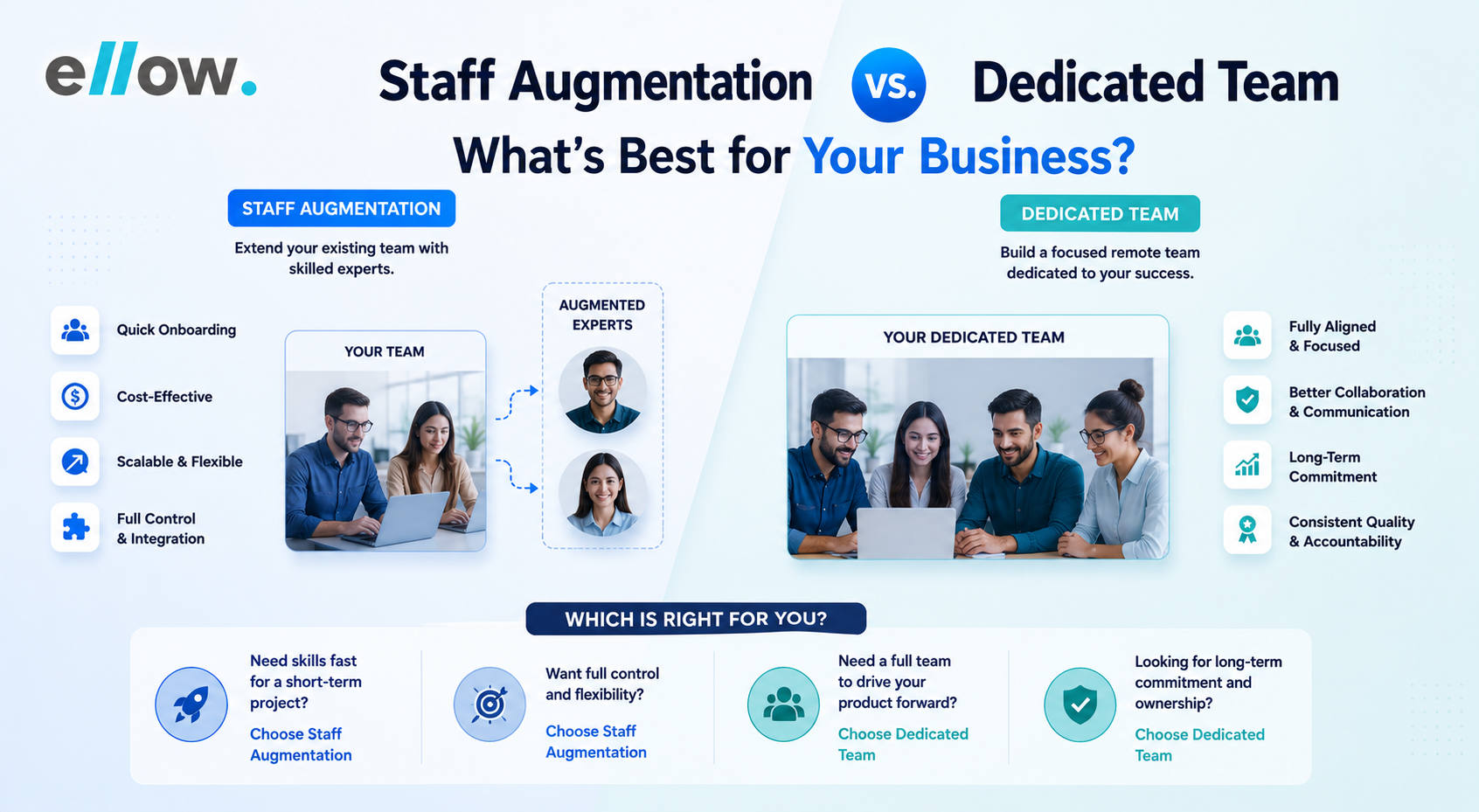
Two of the most popular outsourcing models are IT staff augmentation services and dedicated development teams. While both approaches help organizations access global talent, they serve different business needs and project requirements.
This guide explains the differences, advantages, and ideal use cases for each model, helping you determine which option best aligns with your business goals.
Understanding IT Staff Augmentation Services
IT staff augmentation services involve hiring external professionals to work alongside your existing in-house team. These specialists fill skill gaps, support ongoing projects, or help manage increased workloads without the need for permanent recruitment.
Under this model, augmented staff become an extension of your internal team while remaining employed by the service provider.
Key Characteristics of Staff Augmentation
- Flexible hiring based on project needs
- Quick access to specialized skills
- Direct management by your internal team
- Scalability according to workload demands
- Reduced recruitment and onboarding efforts
This model is particularly useful when businesses need additional expertise without committing to long-term employment contracts.
What Is a Dedicated Team Model?
A dedicated team is a group of professionals exclusively assigned to a client’s project. The team may include developers, project managers, QA engineers, designers, and business analysts who work together as a standalone unit.
Unlike staff augmentation, the dedicated team operates independently while focusing entirely on the client’s objectives.
Key Characteristics of Dedicated Teams
- Full-time commitment to a project
- Long-term collaboration
- Self-managed workflows
- Comprehensive project ownership
- Strong team cohesion and knowledge retention
This approach is ideal for businesses seeking continuous development support for large-scale or evolving projects.
Staff Augmentation vs. Dedicated Team: Key Differences
1. Team Management
Staff Augmentation
Your internal managers oversee the augmented professionals, assign tasks, and monitor performance.
Dedicated Team
The vendor typically handles team management while maintaining regular communication with your business stakeholders.
2. Flexibility
Staff Augmentation
Offers greater flexibility to scale resources up or down based on immediate project requirements.
Dedicated Team
Best suited for long-term projects where consistent resources are needed throughout the development cycle.
3. Cost Structure
Staff Augmentation
Organizations pay for individual specialists as needed, making it cost-effective for short-term requirements.
Dedicated Team
Provides predictable monthly costs and may deliver better value for long-term projects requiring ongoing development.
4. Project Scope
Staff Augmentation
Works best when the project scope is clearly defined and your internal team can manage execution.
Dedicated Team
Suitable for complex projects where the external team takes responsibility for development and delivery.
5. Time to Hire
Staff Augmentation
Allows businesses to quickly onboard experienced professionals, often within days.
Dedicated Team
Requires more planning and team assembly but offers stronger long-term stability.
Benefits of IT Staff Augmentation Services
Many companies choose IT staff augmentation services because of the operational flexibility they provide.
Access to Specialized Talent
Organizations can hire experts in technologies such as:
- Artificial Intelligence (AI)
- Cloud Computing
- DevOps
- Cybersecurity
- Mobile App Development
- Data Analytics
Faster Project Delivery
Additional resources help accelerate development timelines and reduce project bottlenecks.
Lower Recruitment Costs
Businesses avoid expenses associated with:
- Job advertising
- Candidate screening
- Training programs
- Employee benefits
Improved Scalability
Teams can expand during peak workloads and contract when demand decreases.
Reduced Hiring Risks
Companies gain access to pre-vetted professionals without making permanent hiring commitments.
Benefits of a Dedicated Team
A dedicated team offers several advantages for organizations pursuing long-term digital transformation initiatives.
Strong Project Focus
Team members work exclusively on your product, ensuring greater alignment with business objectives.
Better Collaboration
Over time, dedicated teams develop a deep understanding of your processes, goals, and customer needs.
Consistent Knowledge Retention
Unlike temporary staffing arrangements, dedicated teams maintain project knowledge throughout the development lifecycle.
Long-Term Cost Efficiency
For large-scale projects, a dedicated team often proves more economical than repeatedly hiring individual specialists.
Higher Productivity
Established workflows and team cohesion contribute to improved efficiency and project quality.
When Should You Choose IT Staff Augmentation Services?
Staff augmentation may be the right choice if:
- You already have a strong internal development team.
- You need specialized expertise for a short-term project.
- Your project timeline is tight.
- You want full control over project management.
- You need to scale resources quickly.
This model is commonly used by startups, enterprises, and technology companies facing temporary skill shortages.
When Should You Choose a Dedicated Team?
A dedicated team is often the better option if:
- You are developing a long-term software product.
- Your project requirements frequently evolve.
- You need a fully committed development unit.
- Your internal management resources are limited.
- You require continuous support and maintenance.
Dedicated teams are particularly valuable for SaaS platforms, enterprise applications, and large-scale digital transformation projects.
Factors to Consider Before Making a Decision
Before selecting either model, evaluate:
Project Duration
Short-term projects often benefit from staff augmentation, while long-term initiatives may justify a dedicated team.
Internal Expertise
Organizations with experienced technical leadership can effectively manage augmented professionals.
Budget Constraints
Consider both immediate costs and long-term return on investment.
Scalability Requirements
Determine whether your resource needs are likely to fluctuate over time.
Business Objectives
Align your staffing strategy with your overall growth plans and technology roadmap.
Conclusion
Both IT staff augmentation services and dedicated teams offer valuable solutions for modern businesses. The right choice depends on your project complexity, budget, internal capabilities, and long-term goals.
If you need immediate access to specialized talent while maintaining direct control over your project, staff augmentation provides the flexibility and scalability many businesses require. On the other hand, if you’re building a long-term product and need a committed team focused exclusively on your success, a dedicated team may be the better investment.
Carefully evaluating your business objectives and project requirements will help you select the model that delivers the best results and supports sustainable growth.