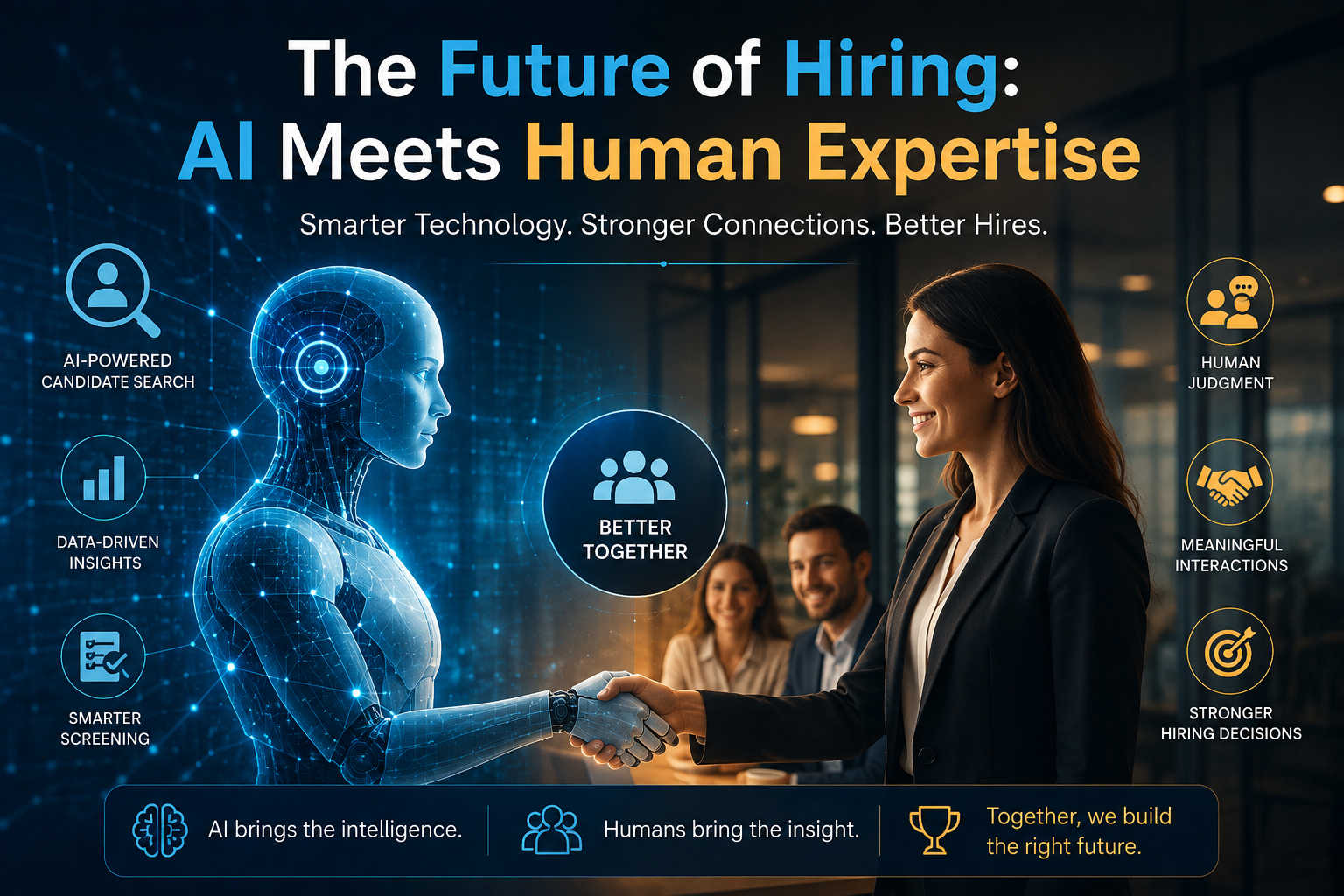
For a while, the conversation around AI in hiring was framed as a straightforward trade-off — either recruiters do the work manually, or AI takes over and does it faster. That framing is already outdated. The companies getting the best hiring outcomes right now aren’t the ones who picked a side; they’re the ones who figured out where AI should lead and where human judgment still has to.
The future of hiring isn’t AI replacing recruiters. It’s AI and recruiters splitting the work along the lines each one is actually good at.
Why “AI vs Human Recruiters” Was Always the Wrong Question
Early conversations about AI in recruitment often framed it as a threat to recruiter jobs. In practice, what’s played out is closer to the opposite. AI has taken over the parts of hiring that were never a good use of a skilled recruiter’s time in the first place — sorting resumes, scheduling interviews, sending status updates, and screening for baseline qualifications.
What’s left for recruiters is arguably the more valuable part of the job: understanding what a hiring manager actually needs beyond the job description, reading how a candidate communicates under pressure, negotiating offers, and making judgment calls on borderline candidates where a resume alone doesn’t tell the full story.
Where AI Leads in the Modern Hiring Process
Sourcing and initial screening. AI systems can scan thousands of candidate profiles against a role’s requirements far faster than any team of recruiters, surfacing a shortlist that would otherwise take days of manual searching.
Structured first-round assessments. Voice AI and conversational screening tools can conduct consistent first-round interviews at scale, asking every candidate the same core questions and flagging responses worth a closer look — particularly valuable for high-volume or frontline hiring where speed matters as much as accuracy.
Scheduling and logistics. Coordinating interview slots across multiple interviewers and candidate time zones is exactly the kind of repetitive, rules-based task AI handles better than a human ever could, freeing recruiters from one of the most time-consuming parts of the process.
Bias-consistent evaluation. Applied carefully, AI can apply the same evaluation criteria to every candidate at the same stage, reducing the day-to-day inconsistency that creeps into manual screening when a recruiter is reviewing candidate fifty of the day versus candidate three.
Where Human Expertise Still Leads
Reading nuance and context. A candidate’s career gap, industry switch, or non-traditional background often needs human judgment to properly contextualize — something AI screening can flag but shouldn’t be left to decide alone.
Understanding the hiring manager’s real intent. Job descriptions rarely capture everything a hiring manager actually wants. Recruiters who build that relationship translate unstated priorities into better candidate searches than any system working off a static job posting.
Culture and team fit. Assessing whether someone will genuinely thrive within a specific team’s dynamics is still a deeply human judgment call, shaped by conversation and observation that’s difficult to fully encode into a scoring system.
Negotiation and closing. Extending an offer, navigating counteroffers, and closing a candidate who has competing options is relationship-driven work — the kind of high-stakes, real-time judgment that AI can support with data but shouldn’t lead.
Final hiring decisions. Even the most sophisticated AI screening should inform a decision, not make it outright, especially for senior, leadership, or highly specialized roles where the cost of a bad hire is significant.
What a Hybrid Hiring Model Actually Looks Like
The strongest hiring processes now typically follow a pattern: AI handles the top of the funnel — sourcing, screening, and initial engagement — while human recruiters take over once a candidate reaches a shortlist stage. This isn’t a rigid handoff; it’s closer to a continuous collaboration where AI surfaces data and flags that inform each human decision point along the way.
For example, a voice AI agent might conduct a structured first-round screening call with a high-volume applicant pool, then hand off a ranked shortlist — complete with notes on communication style, availability, and key qualifications — to a human recruiter who conducts the final interview and makes the hiring call. Neither step replaces the other; each does the part it’s actually suited for.
Why This Matters for Candidate Experience
A well-designed hybrid model doesn’t just help companies hire faster — it tends to improve the candidate experience too. Candidates get faster responses and more transparent communication throughout the process, thanks to AI-driven updates and scheduling, while still getting genuine human interaction at the stages that matter most, like interviews and offer conversations. The combination avoids two common failure modes: the fully manual process that feels slow and unresponsive, and the fully automated process that feels impersonal and transactional.
What Companies Should Do to Prepare
Businesses planning their hiring strategy for the next few years should think less about “should we use AI” and more about where in the process AI adds the most value without removing the human judgment that candidates and hiring managers both rely on. A few starting points:
- Map your current hiring funnel and identify which stages are purely administrative versus which require genuine judgment calls.
- Start with high-volume, repetitive stages — sourcing, screening, and scheduling — where AI delivers the clearest efficiency gains with the least risk.
- Keep recruiters closely involved in tool selection, since they understand where the process actually breaks down better than any vendor pitch will.
- Build in transparency for candidates about where AI is used in the process, since trust in the hiring process is increasingly part of a company’s employer brand.
The Road Ahead
The next phase of hiring technology is likely to blur the line between “AI tool” and “recruiter’s assistant” even further — systems that don’t just screen candidates but actively support recruiters with real-time insights during interviews, predictive signals on candidate fit, and even coaching on how to structure a stronger offer. The companies that adapt fastest won’t be the ones that hand hiring over to AI entirely, but the ones that figure out, stage by stage, exactly where AI should lead and where a human still needs to be in the room.
Frequently Asked Questions
Will AI eventually replace human recruiters?
Unlikely in full. AI is expected to keep taking over repetitive, high-volume tasks like screening and scheduling, while human recruiters remain essential for judgment-heavy work like negotiation, culture fit, and final hiring decisions.
What’s a hybrid AI-human hiring model?
A hybrid model uses AI to handle sourcing, screening, and initial candidate engagement, then hands qualified candidates to human recruiters for interviews, relationship-building, and final decisions, combining speed with judgment.
Does using AI in hiring hurt candidate experience?
Not when implemented well. Many candidates actually prefer the faster responses and clearer communication AI enables, as long as human interaction remains part of the process at key stages like interviews and offers.
Which parts of hiring should stay human-led?
Culture fit assessment, understanding a hiring manager’s real intent, negotiation, and final hiring decisions typically benefit most from human judgment, since these require context and relationship-building that AI can support but not fully replace.
How should a company start adopting AI in its hiring process?
Most companies start by automating the most repetitive, high-volume stages, like resume screening and interview scheduling, before expanding into more advanced areas like structured AI-led first-round assessments.