Let’s buildthe future together.
Great ideas need great people. Partner with us to bring your vision to life, or take the first step in your career by joining our team of innovators.



Receive new articles delivered Straight to your inbox
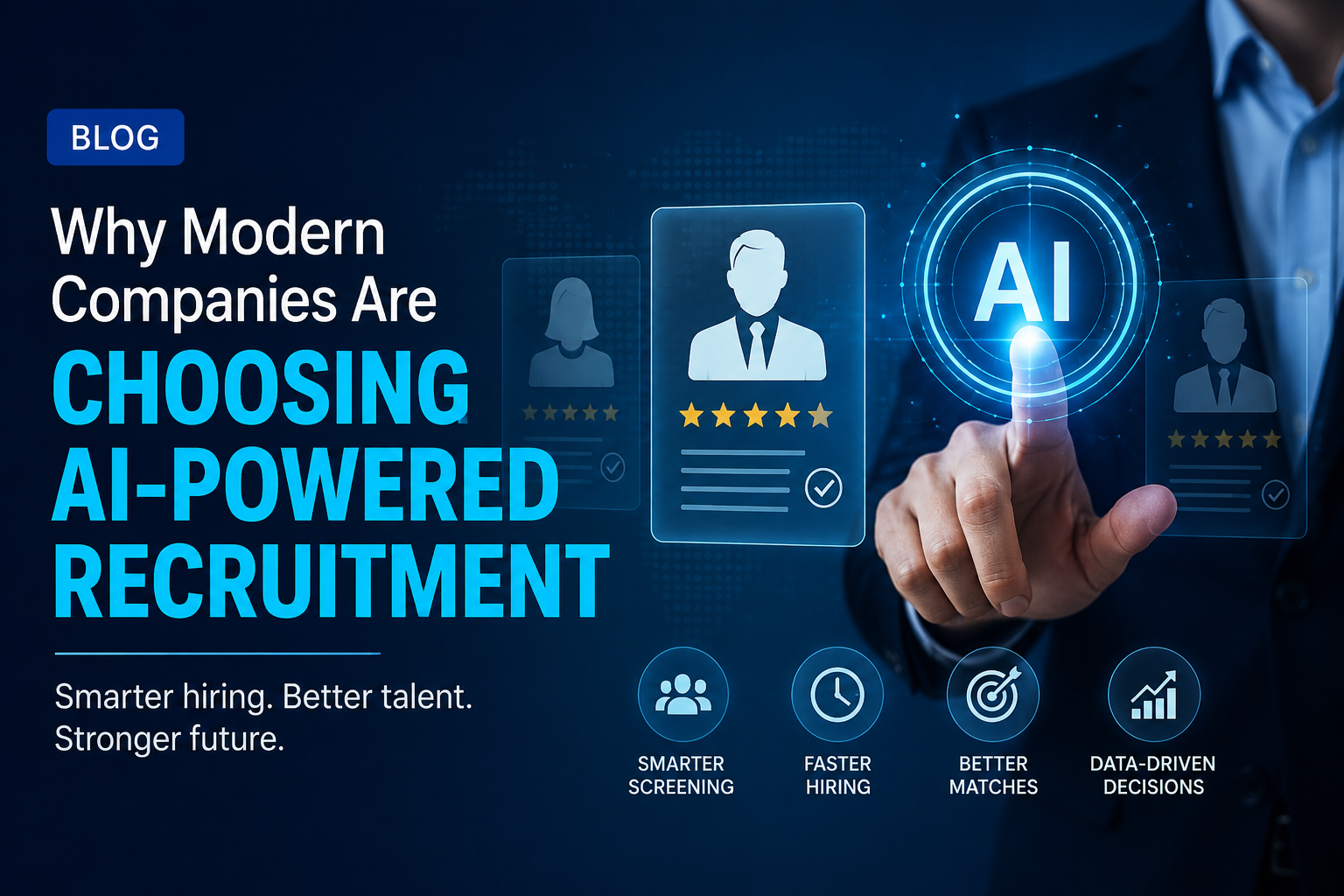
Hiring has quietly become one of the most expensive, time-consuming problems inside most companies. A single open role can take weeks to fill, involve dozens of resume screenings, and still end in a mismatch six months later. It’s no surprise that businesses of every size — from fast-growing startups to large enterprises — are turning to AI-powered recruitment to fix what traditional hiring simply wasn’t built to handle at scale.
This isn’t a passing trend. It reflects a real shift in how companies think about talent acquisition: less manual guesswork, more data-backed decisions, and hiring processes that can keep up with how fast businesses actually need to grow.
AI-powered recruitment refers to the use of artificial intelligence tools to handle parts of the hiring process that used to require entirely manual effort — sourcing candidates, screening resumes, scheduling interviews, assessing skills, and even conducting first-round conversational screening through chatbots or voice AI agents.
Instead of a recruiter manually sifting through hundreds of applications, AI systems can rank candidates based on relevant experience, skills match, and role fit within minutes. This doesn’t remove people from the process — it removes the repetitive, low-value work so recruiters can focus on the parts of hiring that actually require human judgment.
Traditional recruitment relies heavily on manual resume review, gut-feel shortlisting, and recruiter bandwidth — all of which become bottlenecks the moment a company needs to hire at scale or fill specialized roles quickly. A few pressures are pushing companies toward AI-based alternatives:
AI tools can screen and rank hundreds of applications in the time it takes a recruiter to review a handful manually. This dramatically shortens the time between a job posting going live and a shortlist being ready for interviews — often the single biggest factor in whether a company secures top talent before a competitor does.
Rather than relying on keyword matching alone, modern AI recruitment tools evaluate skills, experience patterns, and even soft-skill indicators from structured assessments to identify candidates who are genuinely likely to succeed in a role — not just candidates whose resumes happen to contain the right buzzwords.
When configured thoughtfully, AI screening can apply consistent evaluation criteria across every candidate, reducing the influence of unconscious bias that can creep into manual resume review. This isn’t automatic — it depends on how the underlying system is built and monitored — but it’s a meaningful improvement over purely subjective screening when done correctly.
By automating resume screening, interview scheduling, and initial candidate communication, companies reduce the recruiter hours spent on administrative tasks. Over time, this translates directly into a lower cost-per-hire, especially for companies hiring at high volume.
AI-driven scheduling, faster response times, and conversational AI agents that can answer candidate questions instantly all contribute to a smoother, less frustrating experience for applicants — which in turn improves a company’s employer brand and reduces candidate drop-off during the process.
The biggest difference isn’t just speed — it’s consistency and scale. A human recruiter’s judgment can vary from one candidate to the next depending on time of day, fatigue, or unconscious preference. AI systems apply the same evaluation logic across every applicant, which makes the process more predictable, even if it still requires human oversight to catch edge cases and make final decisions.
Traditional recruitment also struggles to scale linearly — doubling the number of open roles roughly doubles the manual workload. AI-powered systems scale far more efficiently, since the same screening and ranking logic can process ten applications or ten thousand without a proportional increase in recruiter time.
AI recruitment isn’t a plug-and-play fix, and companies adopting it should go in with realistic expectations:
Not every AI recruitment tool solves the same problem. Before choosing one, it’s worth being clear about what you actually need:
Matching the tool to the actual hiring problem — rather than choosing based on marketing claims alone — is usually what separates a genuinely useful AI recruitment investment from a disappointing one.
AI recruitment is moving beyond resume screening and into full conversational hiring experiences — voice AI agents that can conduct structured first-round interviews, multilingual screening for diverse workforces, and predictive tools that flag likely attrition risk before an offer is even extended. As these systems mature, the companies that adopt them early are likely to build a meaningful hiring-speed advantage over those still relying entirely on manual processes.
The shift toward AI-powered recruitment isn’t about replacing recruiters — it’s about giving them the tools to focus on judgment, relationship-building, and closing candidates, while AI handles the repetitive groundwork that used to consume most of their week.
What is AI-powered recruitment?
AI-powered recruitment uses artificial intelligence to automate parts of hiring, like resume screening, candidate matching, interview scheduling, and initial candidate conversations, so companies can hire faster and more consistently.
Is AI recruitment better than traditional hiring?
AI recruitment is generally faster and more consistent for screening large volumes of candidates, but it works best alongside human recruiters, not as a full replacement, especially for final hiring decisions.
Does AI recruitment reduce hiring bias?
Yes, when designed and monitored properly, AI recruitment can reduce bias by applying the same evaluation criteria to every candidate, though it still requires human oversight to catch errors or edge cases.
How much faster is AI recruitment compared to manual hiring?
AI recruitment can screen hundreds of applications in the time a recruiter would need to review a handful manually, significantly shortening the time between posting a job and building a shortlist.
Can AI recruitment handle high-volume frontline hiring?
Yes, many AI recruitment tools are specifically built for high-volume frontline hiring, using voice AI and multilingual support to screen and engage large numbers of candidates quickly.
Will AI replace human recruiters?
No, AI is expected to handle repetitive screening and scheduling tasks, while human recruiters focus on relationship-building, judgment calls, and final hiring decisions that still require human insight.
What should a company look for in an AI recruitment tool?
A company should look for a tool that matches its actual hiring need, whether that’s high-volume frontline hiring, specialized technical vetting, or integration with existing HR systems, rather than choosing based on features alone.
Can AI Recruitment Really Reduce Bias in Hiring? Here's What to Know
Inside an AI-Native Staffing Team: How the Hiring Process Actually Works, Step by Step
AI Recruitment Agency Pricing: What Should You Actually Expect to Pay?
Please feel free to share your thoughts and we can discuss it over a cup of tea.
Get a quote
Software Development Outsourcing Challenges and how to solve them
Best database for web development: A developers guide
Can AI Recruitment Really Reduce Bias in Hiring? Here’s What to Know
