



Let’s buildthe future together.
Great ideas need great people. Partner with us to bring your vision to life, or take the first step in your career by joining our team of innovators.
Python has emerged as one of the favored programming languages. It has high code readability, a comprehensive standard library, and automatic memory management. Over the years, it has gained great popularity in academics, web development, scientific research, and other domains.
Python is growing its publicity by 27% year after year. Let’s dive deeper, observe and match the growing pace of Python in today’s industry.
To gain a clearer insight into the potential applications of Python for your business, it can be helpful to examine how some of the world’s leading companies have utilized the language.
Here are 15 global companies that use Python:
In this piece, you’ll gain insights into Python as a programming language and how it’s integrated into the technology stacks of major companies. Keep reading to discover more!
Python is a high-level, interpreted programming language. It is a dynamically typed language where the variable types are determined at runtime, and differs from static languages.
The language’s simple syntax makes it easy to learn and reduces the maintenance cost. Python supports modules and packages, and promotes program modularity with reusable code. The standard libraries which are available in binary or source form, can be freely distributed across the network, and are available across platforms.
Python was created in the late 1980s by Guido van Rossum. He used to work in the Amoeba Operating System at Dutch National Research Institute for Mathematics and Computer Science (CWI).
The limitations he faced while programming made him frustrated, and this resulted in creating Python. He compared his creation with the British comedy group Monty Python.
Also read: 10 Question You Must Ask Before Hiring A Freelance Developer
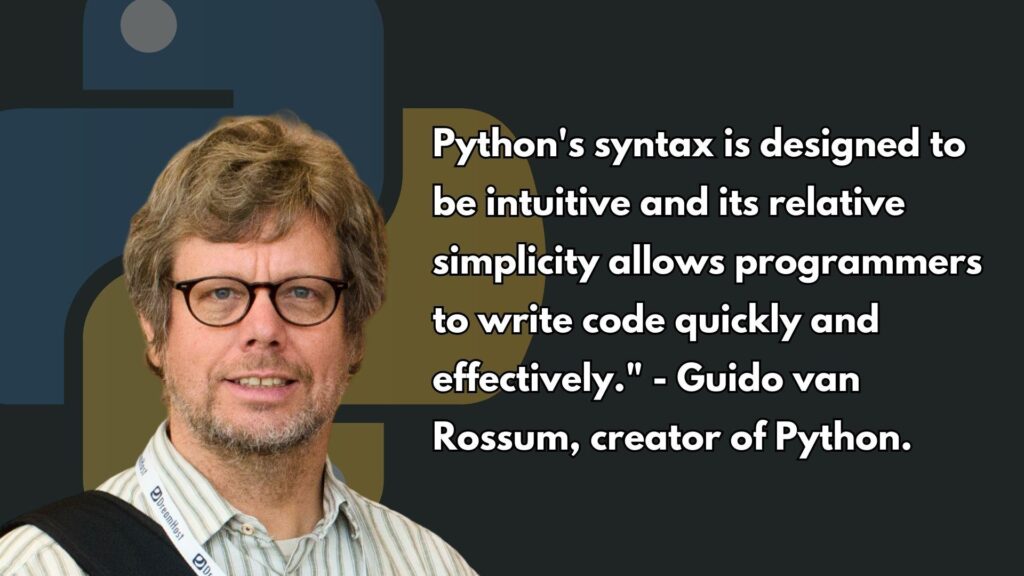
Fun Fact: Python was named after the Monty Python comedy troupe because Guido van Rossum was a fan.
Python released its 1st version in 1991 and gained popularity organically. In 1994, Python’s version 1.0 was released with new features like functional programming and modules.
In 2000, Python 2.0 was released with more features – object-oriented programming, regular expressions, Unicode support, and list comprehensions. In the year 2008, Rossum stepped down as BDFL (Benevolent Dictator For Life) and shifted the ownership of further releases to a group of volunteer contributors and a development team, who could improve the language as per the programming requirements of the time.
In 2008, Python’s version 3.0 was released with some new features – Unicode support, simplified syntax, and changes in how strings are handled. It was used in almost 64.7% of the websites. This version became controversial because the latest updates weren’t compatible with Python’s older versions.
It might also be worth noting that Python 2.x versions are no longer supported, and that developers are encouraged to migrate to Python 3.x.
Despite the discrepancies in the PR, Python never failed to become one of the top programming languages for developers. It is now widely used with various applications, such as machine learning, data science, and web development.
Its toolkit keeps on making the lives of developers/programmers stress-free. It is used in almost 1.5% of server-side programming websites.
Python has been ubiquitous in the spheres of Data Science and Machine Learning. It helps in data cleaning, preprocessing, and the construction of sophisticated Machine Learning models. Both TensorFlow and PyTorch (libraries of Python) have emerged as indispensable resources for developers to build AI-based applications. It is one of the standing premiere languages for AI development and Machine Learning.
Python is an exceptionally proficient language. Its design language helps programmers enhance their problem-solving abilities. The simplistic design helps developers concentrate on resolving the issues standardized rather than leaving them stuck on complex equations.
Such attributes of Python boost productivity, making developers choose it over other programming languages. Python is particularly well-suited for tasks, such as web scraping, data visualization, and automation.
Python’s syntax is created to read and write codes effectively. It is one language developers choose while beginning their journey in programming. Since it is an interpreted language, developers can run each line of code and debug them along the way.
Python has the largest and the most active community of developers. They contribute to developing open-source packages and modules. Beginners or existing programmers can easily install such pre-built models to avoid writing codes from scratch.
They can easily utilize such models by changing the existing code in line with their projects. Developers with open-source libraries can help others who require help by answering their doubts and providing suggestions.
Some popular Python Open source liabraries are:
Python’s cross-platform compatibility makes it one of the best programming languages. Its code isn’t compiled into machine codes; instead, a software program, i.e., Python Interpreter.
This makes it easy for other operating systems, such as Linux, Windows, macOS, FreeBSD, Ubuntu Long Term Support, CentOS, etc., to run a program, making Python a compatible programming language. It can be used in various web and mobile servers and desktop applications.
Determining a variable in a code becomes easy with Dynamic Typing. Python allows programmers to assign value to a variable and store it in a memory location. Because of this, developers can avoid assigning variables again and again. This allows the code to access the memory container by calling out a variable name whenever required.
Python has the ability to embed its code extensively into other languages. As a developer, you can easily put your Python code in the source code and use it in other programming languages. Python’s C API allows it to incorporate Python as a scripting language.
This helps developers to extend the functionalities of the applications. Its capabilities extend to web development as it can be integrated into web servers like Apache and Nginx. This allows developers to create web applications on Python as the back-end language.
Also read: OKRs for your software development team
Python is a powerful and widely utilised programming language with many prominent users. Python is used by companies like Dropbox, Quora, Uber, Airbnb, NASA, Pixar, Netflix, Facebook, Spotify, Instagram, Pinterest, Reddit and a number of other big companies. Google uses Python for various purposes such as building their web crawlers, data analysis, and machine learning.
Python has also been employed in the creation of numerous well-known software applications. The initial BitTorrent client, for example, was developed in Python. Python is also commonly used as a programming language to operate Maya, the industry-standard 3D modelling and animation software.
Let’s discuss discuss more on how Python in production has created global marvels for customers worldwide.
For a search engine to work flawlessly for users around the globe, Google stood above the rest with the help of Python. The developers of Google maintained and developed the website using both C++ and Python. C++ for memory control where low latency was required, and Python was used to maintain the website and steady fast delivery of responses. Most scripts were written in Perl and Bash, but those were recorded in Python because of the ease of their deployment.
One fun fact, the first web-crawling spider was written in Java 1.0, but it became difficult for developers/programmers to maintain it.
Hence they re-wrote it into Python. Python has now become one of the official server-side languages for Google.
Another fun fact, Guido van Rossum, the creator of Python, himself worked with Google from 2005-2012.
Instagram is one of the most popular social media companies that use Python, which makes it accessible to users across the globe. It has the capacity to handle a database of more than a billion users. It was built using Python and Django frameworks. Instagram uses Python for business because it can handle business logic to help maintain 80 million monthly active users.
The back-end of Instagram is primarily written in Python, and the front-end was built using JavaScript. It helped build a dashboard to handle requests, manage databases, and data processing.
The National Aeronautics and Space Administration is responsible for building, managing, controlling, and running civilian space programs and aeronautics research. Their day-to-day activities include data processing and analysis, which Python perfectly handles.
NASA uses Python’s libraries NumPy, SciPy, and Pandas for scientific computing and data analysis. It helps in processing large amounts of data and generates valuable insights. Python also helps in automation tasks such as data collection and time management. The scripts deployed using Python help automate various tasks, saving time and reducing errors.
Spotify is a music platform that helps users listen to a global music library, create a playlist, react to songs, and interact with other users. It is one of the global companies that uses Python to build a back-end that helps resolve platform issues.
Python for business in Spotify helps in tasks like user authentication, management of databases, data analysis, and more. It uses Python libraries like Flask and PyMongo to build web applications and manage tasks. The backend is built with ZeroMQ and connected to a custom messaging protocol to multiple independent services.
Spotify relies on Luigi, an ETL (Extract, Transform, Load) tool based on Python. Luigi allows developers to schedule, manage and monitor batch jobs.
Also read: Your roadmap from a junior software developer to a team leader
Reddit is an online news aggregation and discussion portal where people across the globe share content on diverse topics. For such a platform to stay active for the users all the time requires a steady backend to manage issues.
Python fulfills multiple objectives for Reddit in the spheres of web development, data analysis, and machine learning. Its system was built using Python web framework Pylons. The developers used extensive libraries such as Pandas, NumPy and Matplotlib which helped perform functions like data analysis and visualizations.
Apart from that, TensorFlow, Keras and Scikit-learn were used to work around machine learning tasks such as text classification, image recognition, and recommendation systems.
Python can be used for a wide range of applications, and these companies use it for various purposes, such as:
Python is one of the world’s preferred languages. Its versatility helps programmers/developers achieve the best outcomes in their day-to-day, from minor to major tasks. From 1980 to 2023, Python has grown its usability across various fronts. We’ve learned the multifacet benefits of Python, understood its scope, and valued Python in production – creating the world’s best customer-serving websites.
Are you looking for a Python developer for your organization? We will help you hire one for your organization. Connect with us to know more.
Python is used in many different industries, including technology, finance, healthcare, and education, among others. However, the technology industry is perhaps the largest user of Python. This is because Python has a wide range of applications in software development, from web development and data analysis to machine learning and artificial intelligence.
Here are seven well-known apps that were made using Python:
There are many multinational corporations (MNCs) that use Python for various purposes such as data analysis, machine learning, web development, automation, and more. Some of the well-known MNCs that use Python include Google, Facebook, Netflix, Dropbox, Instagram, and Amazon.
Python is in demand in several fields, including:


Great ideas need great people. Partner with us to bring your vision to life, or take the first step in your career by joining our team of innovators.

Looking to build your career in development? team@ellow.io