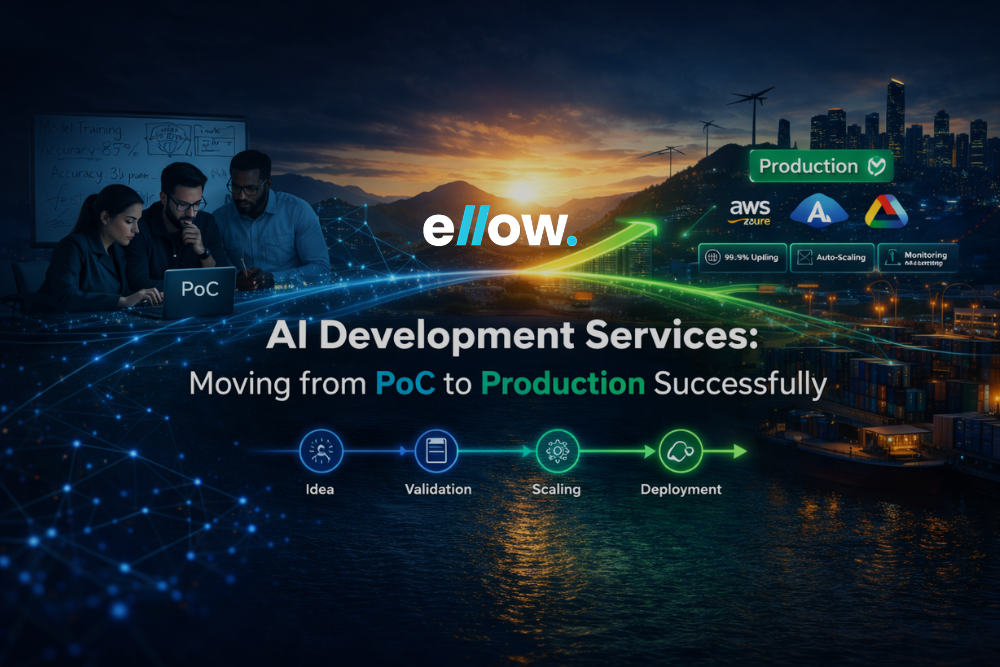
Artificial intelligence has moved beyond experimentation and into the core of business strategy. Organizations across industries are investing heavily in AI to improve efficiency, unlock insights, and create competitive advantage. Yet, despite this momentum, a significant gap remains between early experimentation and real-world impact. This gap has led many organizations to increasingly rely on AI development services to move beyond experimentation.
Recent research highlights just how wide this gap is. A study from MIT found that up to 95% of AI projects fail to deliver measurable business value, while other industry estimates suggest that 70–85% of AI initiatives fall short of expectations. Even more telling, Gartner reports that at least 50% of AI projects are abandoned after the Proof of Concept stage, often due to unclear business value, poor data readiness, or rising costs.
This pattern is consistent across industries. While Proofs of Concept frequently demonstrate technical feasibility, they rarely translate into production systems that deliver sustained, measurable outcomes. The challenge is not building models, it is operationalizing them within complex, real-world environments.
This is where AI development services providers play a critical role. They bring the structure, expertise, and execution discipline required to move AI from isolated experiments to scalable, production-ready systems that drive tangible results.
Why Most AI PoCs Fail Before Production
Despite strong initial momentum, a large share of AI initiatives stall before they ever reach production. The issue is rarely model capability. More often, it comes down to gaps in execution, alignment, and operational readiness. Organizations that lack structured AI development services often struggle to bridge these execution gaps.
1. Weak Link to Business Outcomes
Many AI PoCs are initiated as exploratory exercises rather than outcome-driven initiatives. While they may demonstrate technical feasibility, they often lack a direct connection to measurable business impact.
Without clearly defined success metrics tied to revenue, cost efficiency, or operational performance, these projects struggle to justify further investment or scaling. Without this alignment, even well-funded AI development services initiatives struggle to justify scaling beyond initial pilots.
2. Data That Works in Theory, Not in Reality
PoCs are typically built on curated, static datasets that do not reflect real-world complexity. Once moved closer to production, issues surface quickly:
- Inconsistent data formats
- Missing or incomplete records
- Lack of real-time availability
The transition exposes a fundamental gap between controlled experimentation and production-grade data environments.
3. Failure to Integrate Into Existing Systems
AI models do not create value in isolation. Their impact depends on how effectively they are embedded into existing systems and workflows.
In many cases, PoCs remain standalone prototypes. They are not integrated with core systems such as CRM, ERP, or internal tools, which limits their ability to influence actual decisions or actions.
4. Fragmented Ownership Across Teams
AI initiatives often sit across multiple functions, including data science, engineering, and business teams. However, ownership of outcomes is rarely unified.
This leads to situations where:
- Models are technically sound but not operationalized
- Infrastructure is ready but lacks business adoption
- Stakeholders are aligned on intent but not on execution
Without clear accountability, projects lose momentum.
5. No Defined Path to Scale
A successful PoC proves feasibility, but it does not address scalability. Production environments require:
- Deployment pipelines
- Monitoring and governance frameworks
- Cost management strategies
- Ongoing model maintenance
These elements are often not considered early enough, resulting in rework, delays, or complete abandonment. This is where structured AI development services frameworks help organizations move from feasibility to scalability.
What AI Service Providers Do Differently
The gap between a successful PoC and a production system is rarely caused by model limitations. In most cases, the underlying algorithms work as expected.
The breakdown happens in execution, where systems need to operate reliably within complex environments, interact with existing workflows, and deliver measurable outcomes at scale. Leading AI development services firms address these challenges by combining technical execution with operational discipline.
AI service providers approach this differently. Their focus is not on validating isolated use cases, but on building systems that can sustain performance, integrate into business operations, and generate continuous value.
1. Start With Business Outcomes, Not Technical Possibilities
A large number of AI initiatives begin with exploratory questions such as “what can we build with this data” or “how can we use AI here.” While useful for experimentation, this approach rarely translates into production success.
Service providers invert this process. They begin by defining a clear value hypothesis tied to a business objective, such as improving conversion rates, reducing operational costs, or optimizing resource allocation.
This involves:
- Identifying where decisions are currently inefficient or manual
- Quantifying the potential impact of improvement
- Defining success metrics that can be measured post deployment
By anchoring the initiative in a business outcome, the PoC becomes a validation of value, not just feasibility. This creates a clear path for investment and scaling.
2. Treat Production Constraints as First-Class Requirements
Internal teams often optimize PoCs for speed and accuracy, deferring production considerations until later. This creates a disconnect when systems need to scale.
Service providers treat production constraints as part of the initial design problem. This includes:
- Handling real-world latency requirements
- Ensuring system reliability and uptime
- Managing cost efficiency at scale
- Meeting security, compliance, and governance standards
Architectural decisions are made with these constraints in mind, whether that involves model selection, infrastructure setup, or system design.
The result is a system that does not need to be reengineered when moving from validation to deployment. This production-first approach is a defining characteristic of mature AI development services providers.
3. Build Data Systems That Reflect Operational Reality
One of the most underestimated challenges in AI is the difference between experimental data and production data.
PoCs are typically built on static, cleaned datasets. Production systems must operate on dynamic, incomplete, and often inconsistent data streams.
Service providers address this by focusing on:
- Building resilient data pipelines that can handle variability
- Implementing validation and quality checks at multiple stages
- Aligning data structures with real business processes
- Ensuring continuous data availability for inference
They also account for feedback loops, where model outputs influence future data inputs.
This shift from dataset preparation to data system design is critical for sustained performance. Robust data engineering is a core component of effective AI development services, not a secondary consideration.
4. Embed AI Into Decision and Execution Layers
AI creates value only when it influences decisions or automates actions.
A common failure pattern is deploying models that generate outputs but are not integrated into the systems where decisions are made. This results in insights that are observed but not acted upon.
Service providers focus on embedding AI into:
- Transactional systems
- Operational workflows
- Decision support interfaces
This may involve triggering actions directly, augmenting human decision making, or automating entire processes.
For example, instead of generating a risk score, the system is designed to initiate a predefined response based on that score.
This integration is what converts model performance into business impact.
5. Engineer for Adoption as a System Requirement
Adoption is often treated as a change management problem after deployment. In practice, it is a design problem.
Service providers incorporate adoption into the system design itself by:
- Aligning outputs with existing user workflows rather than introducing new ones
- Minimizing friction in how insights are accessed and acted upon
- Ensuring that the system enhances, rather than disrupts, current processes
They also involve end users during development to validate usability and relevance.
This approach recognizes that even highly accurate models fail if they are not consistently used in real decision contexts.
6. Operationalize AI Through Continuous Lifecycle Management
Unlike traditional software systems, AI systems are inherently dynamic. Their performance can degrade over time due to changes in data, behavior, or external conditions.
Service providers address this by building an operational layer around the model, which includes:
- Continuous monitoring of model performance and output quality
- Detection of data drift and concept drift
- Automated retraining and versioning mechanisms
- Performance benchmarking against defined KPIs
They also incorporate observability into the system, enabling teams to understand not just whether the model is working, but how and why it is behaving in certain ways.
This ensures that the system remains reliable and aligned with business objectives over time.
7. Align Execution Across Business, Data, and Engineering Functions
AI initiatives sit at the intersection of multiple disciplines. Misalignment across these functions is one of the most common reasons projects stall.
Service providers act as a coordinating layer, ensuring that:
- Business teams define clear objectives and constraints
- Data teams provide relevant and usable datasets
- Engineering teams build scalable and maintainable systems
They establish shared metrics, governance structures, and communication loops that keep execution aligned throughout the lifecycle.
This reduces the risk of technically sound systems failing to deliver operational value.
8. Leverage Repeatable Frameworks to Reduce Execution Risk
Building AI systems from scratch introduces significant uncertainty.
Service providers mitigate this by using repeatable delivery frameworks based on prior implementations. These frameworks typically include:
- Standardized phases for discovery, validation, deployment, and scaling
- Reusable architectural patterns
- Pre-built components for common use cases
- Established best practices for data, modeling, and deployment
This allows them to anticipate challenges, avoid common failure points, and accelerate time to production.
It also increases consistency in outcomes across different projects and environments.
The AI Service Provider Delivery Framework
AI service providers do not approach delivery as a linear handoff from experimentation to deployment. Instead, they operate through a structured, iterative framework that aligns business objectives, data systems, and technical execution from the outset.
The goal is not just to validate a use case, but to build a system that can perform reliably under real-world conditions and scale across the organization. Most enterprise AI development services engagements follow a structured version of this delivery model.
Phase 1: Problem Framing and Value Definition
This phase establishes the foundation for everything that follows. Rather than starting with data or models, service providers begin by clarifying the business context.
Key activities include:
- Identifying high impact use cases tied to measurable business outcomes
- Mapping current processes and identifying inefficiencies or decision gaps
- Defining success metrics that will be used to evaluate impact post deployment
- Assessing feasibility based on available data, systems, and constraints
This stage ensures that the initiative is anchored in value, not just technical curiosity. It also helps prioritize use cases that justify the investment required for production.
Phase 2: PoC With Production Intent
Unlike traditional PoCs that are built as isolated experiments, service providers design PoCs as early versions of production systems.
The focus here is twofold:
- Validate that the approach can deliver the intended outcome
- Surface constraints that may impact scalability or integration
This typically involves:
- Testing models on representative datasets rather than idealized samples
- Evaluating performance under realistic conditions
- identifying dependencies on data pipelines, infrastructure, or external systems
By treating the PoC as a scaled down production environment, providers reduce the risk of failure during later stages.
Phase 3: Data and Infrastructure Readiness
Once feasibility is established, the focus shifts to building the foundation required for reliable deployment.
This phase often determines whether the system can scale effectively.
Key components include:
- Designing and implementing data pipelines that can support continuous input and output
- Establishing data governance, validation, and quality controls
- Setting up infrastructure that supports model deployment, including cloud environments and APIs
- Ensuring compliance with security and regulatory requirements
At this stage, the emphasis is on stability and consistency, ensuring that the system can operate under real-world conditions without degradation.
Phase 4: System Integration and Deployment
With the foundation in place, the system is integrated into the organization’s existing environment.
This is where AI begins to move from a standalone capability to an embedded operational system.
Activities include:
- Integrating models with core business systems such as CRM, ERP, or internal platforms
- Embedding outputs into workflows where decisions are made
- Enabling automated or semi-automated actions based on model outputs
- Training users and aligning teams around the new system
Deployment is not treated as a one-time event, but as the beginning of continuous operation. This stage is where AI development services deliver the most visible business impact by embedding intelligence directly into operations.
Phase 5: Monitoring, Optimization, and Scaling
Production AI systems require ongoing management to remain effective.
Service providers implement mechanisms to ensure that performance is sustained and improved over time.
This includes:
- Monitoring model performance against defined business and technical metrics
- Detecting data drift, concept drift, and changes in system behavior
- Retraining and updating models as needed
- Optimizing infrastructure and cost efficiency
- Expanding the system to additional use cases or business units
This phase transforms AI from a one-time implementation into a continuously evolving capability.
Real Impact: What Happens When AI Reaches Production
The real value of AI is not realized at the PoC stage. It emerges only when systems are deployed, integrated, and consistently used within business operations.
When AI reaches production, the shift is measurable. It moves from isolated insights to continuous, system-level impact.
For instance, studies have shown that AI-assisted development workflows can improve productivity by over 30% in enterprise environments, accelerating output while maintaining quality. At the same time, automation of repetitive and decision-heavy processes reduces reliance on manual effort and external dependencies, leading to improved operational efficiency and cost control.
However, the most significant impact of production AI is not limited to isolated gains. It fundamentally changes how organizations operate.
Production systems enable:
Continuous Improvement at Scale
Unlike static systems, AI models evolve over time. As they process more data and adapt to changing conditions, their performance improves. This creates a feedback loop where the system becomes more effective with usage, rather than degrading or becoming obsolete.
Faster and More Informed Decision Making
AI systems embedded within workflows reduce the time between data capture and action. Decisions that previously required manual analysis or multiple layers of approval can now be supported or automated in real time.
This compression of decision cycles has a direct impact on responsiveness, efficiency, and competitiveness.
Compounding Return on Investment
The value of production AI compounds over time. Initial use cases often expand into adjacent areas, leveraging the same data pipelines, infrastructure, and models.
What begins as a single deployment evolves into a broader capability, enabling organizations to extract increasing value without proportional increases in cost.
In essence, production AI shifts organizations from reactive decision making to continuously optimized operations.
Build vs Partner: Why Services Win
As organizations look to scale AI, a common question arises: should capabilities be built internally, or should they be developed in partnership with external providers?
While building in-house offers control, it also introduces significant complexity. Many internal initiatives struggle to move beyond early experimentation due to challenges in scaling, integration, and sustained execution.
In contrast, organizations that partner with AI service providers tend to achieve faster and more consistent outcomes.
This difference is not incidental. It is structural.
Internal teams often face:
- Limited experience with end-to-end AI deployment
- Fragmented ownership across functions
- Longer timelines to build infrastructure and processes
- Difficulty translating models into operational systems
Service providers, on the other hand, bring a different operating model.
They contribute:
Experience Across Multiple Deployments
Having worked across industries and use cases, service providers have direct exposure to what works and what fails in production environments. This allows them to anticipate challenges and avoid common pitfalls.
Pre-Built Frameworks and Accelerators
Instead of building systems from first principles, service providers leverage reusable architectures, components, and delivery frameworks. This significantly reduces development time and execution risk.
Cross-Industry and Cross-Use Case Learning
Patterns observed in one domain can often be adapted to another. Service providers bring this perspective, enabling more efficient problem solving and faster iteration.
Outcome-Oriented Execution
Perhaps the most important distinction is focus. Service providers are measured on delivery and impact, not just technical output.
Their mandate is not to experiment, but to ensure that systems are deployed, adopted, and delivering measurable value.
This does not mean that internal capabilities are unnecessary. Over time, organizations often build internal expertise.
However, for moving from PoC to production, partnering with experienced service providers consistently accelerates execution and improves success rates.
Key Takeaways
The transition from PoC to production is often framed as a technical challenge. In reality, it is primarily an execution challenge.
Success depends on how well organizations align strategy, data, technology, and operations into a cohesive system.
The patterns observed across successful deployments are consistent:
- Clear alignment with business objectives from the outset
- Systems designed with production constraints in mind
- Strong and reliable data foundations
- Deep integration into workflows and decision processes
- Continuous monitoring, optimization, and lifecycle management
- Alignment across business, data, and engineering teams
These elements do not emerge organically. They require deliberate design and disciplined execution.
This is where AI service providers create the most value, by bringing structure, experience, and operational rigor to the entire lifecycle.
Final Thoughts
The conversation around AI is shifting.
The question is no longer whether AI can work. In most cases, it can. The real question is whether it can be deployed, scaled, and sustained in a way that delivers meaningful outcomes.
Organizations that continue to treat AI as a series of experiments will remain caught in cycles of PoCs, generating insights without impact.
Those that focus on execution, system design, and operational integration will move beyond experimentation and unlock real value. Organizations that effectively leverage AI development services are better positioned to move from experimentation to sustained impact.
The future of AI does not belong to those who build the most models.
It belongs to those who can deploy systems that work reliably in the real world.
Because ultimately, AI is not defined by what is built in isolation.
It is defined by what is successfully implemented, adopted, and scaled.