Let’s buildthe future together.
Great ideas need great people. Partner with us to bring your vision to life, or take the first step in your career by joining our team of innovators.


Receive new articles delivered Straight to your inbox
If you’ve hired for a role in the last year, you already know the problem: too many applicants, not enough time, and a nagging fear that the best candidates are getting missed in the noise — or hired by someone else before you even finish screening resumes. Traditional hiring wasn’t built for the volume and speed today’s job market demands.
That’s why more business owners are turning to an AI Talent Agency instead of managing recruitment entirely in-house or relying on a traditional staffing firm. Unlike agencies that bolt AI onto an old process, an AI-native agency is built around it from day one — every stage of sourcing, screening, and matching runs through intelligent systems designed to move faster without sacrificing quality.
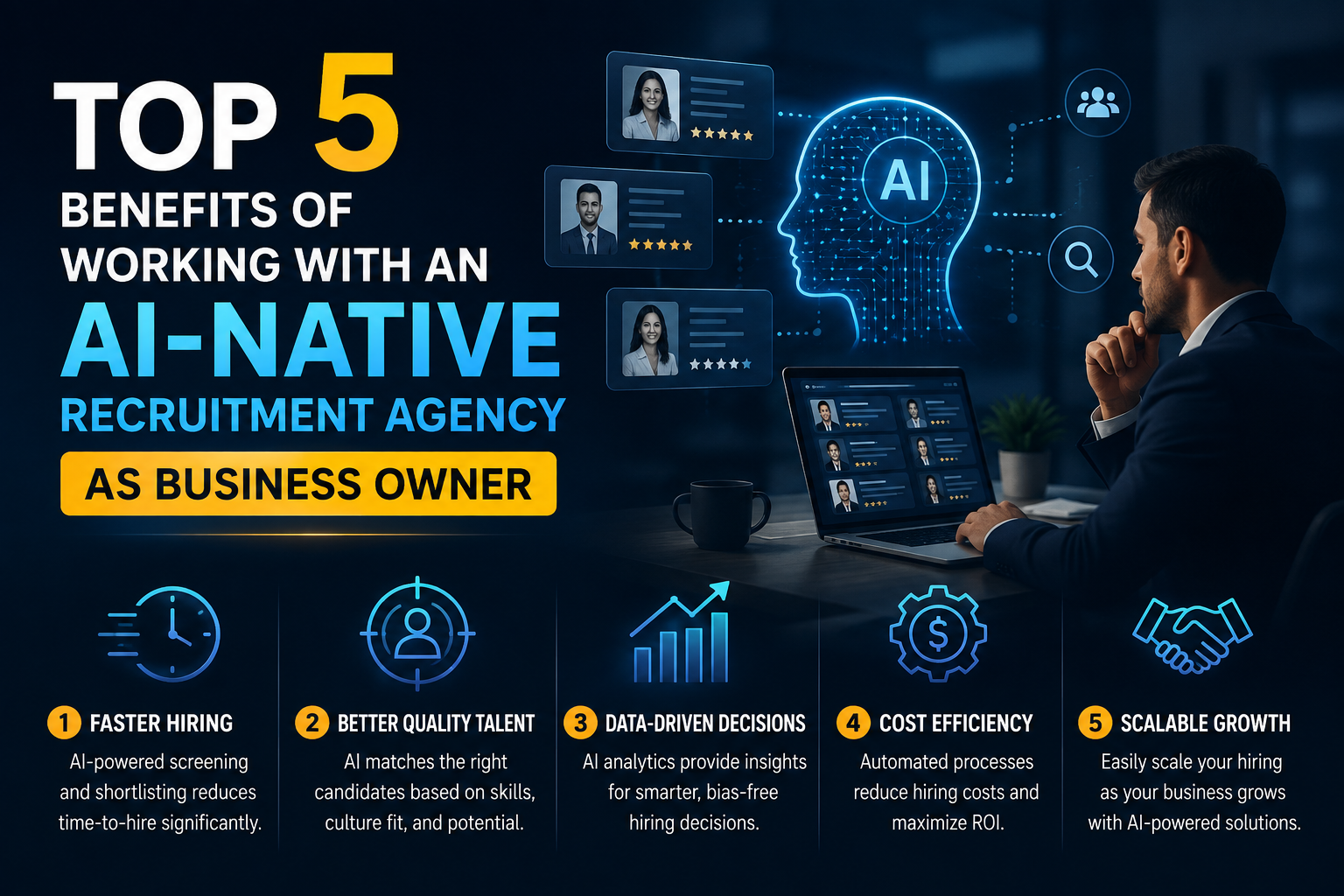
Here are the five biggest benefits business owners see when they make the switch.
Speed is the most immediate benefit business owners notice. An AI Recruiting Agency can screen hundreds of applications, rank candidates by fit, and surface a shortlist in a fraction of the time a manual process takes. Instead of spending weeks sorting resumes and coordinating first-round interviews, business owners often see qualified candidates within days.
This matters more than it might seem. Every day a critical role sits open costs money — in lost productivity, delayed projects, and added pressure on the rest of the team. Cutting time-to-hire from weeks to days isn’t just convenient; it directly protects the bottom line.
Speed without quality isn’t a win — it just means making bad hires faster. This is where AI Recruitment Services genuinely outperform manual screening. Rather than relying on keyword matching, modern AI matching engines analyze context: related skills, career trajectory, and role-specific signals that a human reviewer skimming hundreds of resumes is likely to miss.
The result is a shortlist of candidates who are functionally a strong fit, not just candidates whose resumes happen to contain the right buzzwords. For business owners, that translates into fewer mismatched hires, less time spent re-interviewing for the same role, and lower turnover down the line.
Finding specialized talent — developers, engineers, data scientists, niche technical roles — is one of the hardest parts of hiring for a small or mid-sized business that doesn’t have a dedicated technical recruiter on staff. AI Staffing Solutions solve this by maintaining a continuously screened talent pool, so business owners aren’t starting from zero every time a role opens up.
Because candidates are typically vetted across multiple stages — skills testing, technical review, and interviews — before they’re ever presented to a client, business owners spend less time filtering out unqualified applicants and more time actually evaluating people they’d genuinely consider hiring.
It’s easy to assume that AI-driven hiring costs more because of the technology involved, but the opposite is usually true. Manual recruiting is expensive in ways that don’t always show up on an invoice: recruiter hours spent screening unqualified applicants, extended vacancy costs, and the price of a bad hire that doesn’t work out.
By automating the repetitive, time-consuming parts of recruitment, an AI Hiring Platform reduces the total resources needed to fill a role. Business owners get the benefit of a leaner hiring process without giving up the human judgment needed for final decisions — recruiters spend their time on interviews and negotiation instead of resume triage.
Hiring needs rarely stay flat. A business might need to fill one role this quarter and ten the next, especially during a growth phase or a new project launch. Building an internal recruitment team sized for peak demand is expensive and inefficient the rest of the time.
Working with an AI-native agency gives business owners elastic hiring capacity — the ability to scale sourcing and screening up or down based on actual need, without carrying the fixed cost of a large in-house recruiting function. This flexibility is especially valuable for businesses that hire in bursts tied to funding rounds, seasonal demand, or project-based work.
This shift isn’t happening in isolation. Broader workforce research has consistently shown that recruiting teams adopting AI-assisted tools report faster hiring cycles and improved candidate quality compared to those relying solely on manual processes, according to workforce trend research published by LinkedIn’s Talent Solutions team. As competition for skilled talent continues to intensify across industries, that gap between AI-assisted and fully manual hiring is likely to keep widening.
Not every agency claiming to use AI is truly AI-native. Some simply layer basic automation — like auto-scheduling — onto an otherwise manual process. A genuinely AI-native agency, like ellow.io, builds intelligent matching and vetting into the core of how it sources and evaluates candidates, combining that technology with experienced recruiters who handle the parts of hiring that still require human judgment. For business owners, the difference shows up clearly in how fast — and how well — open roles actually get filled.
What is an AI-native recruitment agency?
An AI-native recruitment agency is built from the ground up around artificial intelligence, rather than adding AI tools onto a traditional process. AI is used at every stage — sourcing, screening, matching, and often initial assessment — working alongside human recruiters rather than replacing them.
How is an AI recruiting agency different from a traditional staffing agency?
Traditional staffing agencies typically rely on manual resume review and recruiter networks to fill roles, which can take weeks. An AI recruiting agency uses automated screening and predictive matching to narrow down qualified candidates much faster, while still using human recruiters for interviews and final vetting.
Is AI recruitment only useful for large companies?
No. Small and mid-sized businesses often benefit the most, since they typically don’t have the internal resources for a dedicated technical recruiting team. AI staffing solutions give smaller businesses access to the same speed and candidate quality that larger companies get from in-house recruiting departments.
Does using an AI hiring platform reduce the quality of candidate evaluation?
When implemented well, it improves it. AI handles the repetitive, high-volume parts of screening, while human recruiters focus their time on interviews, cultural fit, and final decision-making — the parts of hiring where human judgment genuinely matters most.
How quickly can an AI-native agency fill a role compared to traditional hiring?
Timelines vary by role complexity, but many AI-native agencies can present a shortlist of vetted candidates within days rather than the multiple weeks a fully manual process typically takes, particularly for specialized technical positions.
Is AI recruitment more expensive than traditional hiring?
Generally not. By reducing the manual hours spent on screening and lowering the risk of costly mismatched hires, AI-driven recruitment often ends up being more cost-effective per successful hire than fully manual processes.
Can AI Recruitment Really Reduce Bias in Hiring? Here's What to Know
Inside an AI-Native Staffing Team: How the Hiring Process Actually Works, Step by Step
AI Recruitment Agency Pricing: What Should You Actually Expect to Pay?
Please feel free to share your thoughts and we can discuss it over a cup of tea.
Get a quote
Software Development Outsourcing Challenges and how to solve them
Best database for web development: A developers guide
Can AI Recruitment Really Reduce Bias in Hiring? Here’s What to Know
