Recruitment has always been about matching people to roles, but the methods recruiters use have transformed dramatically. Traditional recruitment relied on human networks, manual screening, intuition, and long cycles of interviews. AI recruitment introduces automation, data-driven decision-making, and machine learning to speed up and scale hiring. Both approaches aim to find the right candidate, yet they differ in process, efficiency, bias management, candidate experience, and strategic value. Understanding these differences helps hiring managers and talent teams choose the right mix for their needs.
What traditional recruitment looks like
Traditional recruitment is rooted in human judgment and manual work. Recruiters source candidates through job boards, referrals, campus drives, and networking. They read resumes, call candidates, and conduct interviews based on experience, gut feel, and professional intuition. Key features include:
- Human-led sourcing: Recruiters actively search job boards, attend events, and rely on referrals and passive outreach.
- Manual screening: CV review is done by humans who look for keywords, job history, and cultural fit.
- Interview-heavy assessment: Multiple rounds of interviews—phone screens, technical interviews, and face-to-face meetings—determine suitability.
- Relationship focus: Recruitment builds long-term relationships, mentorship, and employer branding through personalized communication.
- Slower cycles: Screening, scheduling, and coordinating interviews often take weeks to months.
Strengths of traditional recruitment
- Deep context and nuance: Human recruiters understand context, career narratives, and cultural fit better than automated systems.
- Strong candidate relationships: Personalized contact builds trust and improves employer branding.
- Flexibility and judgment: Recruiters can adapt criteria in real time when a candidate shows unexpected potential.
Limitations of traditional recruitment
- Scalability issues: Manually screening hundreds or thousands of applicants is time-consuming and costly.
- Inconsistent objectivity: Human biases and fatigue can skew decisions.
- Inefficiency: Administrative tasks like scheduling and follow-ups consume resources.
What AI recruitment looks like
AI recruitment uses automation, natural language processing (NLP), and predictive analytics to support or replace parts of the hiring process. Systems ingest resumes, evaluate skills, parse job descriptions, and can even analyze video interviews or coding tests. Key features include:
- Automated sourcing: AI scans job boards, internal talent pools, and social profiles to identify likely candidates.
- Intelligent screening: NLP and machine learning rank candidates by fit, extracting skills and experience more quickly than manual review.
- Predictive analytics: Models predict candidate success or retention probability based on historical data and performance indicators.
- Automation of administrative tasks: Scheduling, interview coordination, and candidate communications are automated.
- Enhanced matching: Semantic matching looks beyond exact keyword overlap to identify transferable skills.
Strengths of AI recruitment
- Speed and volume: AI processes thousands of applications in the time a human would handle a few dozen.
- Consistency and repeatability: Algorithms apply the same criteria across candidates, reducing random variance.
- Data-driven insights: Dashboards and analytics reveal bottlenecks, diversity metrics, and time-to-hire trends.
- Cost efficiency: Automation reduces recruiter hours spent on routine tasks.
Limitations and risks of AI recruitment
- Algorithmic bias: If training data reflects historical biases, AI can perpetuate them unless actively corrected.
- Overreliance on data proxies: Predictive models might prioritize proxies (e.g., education from certain schools) that don’t equate to on-the-job success.
- Candidate experience pitfalls: Over-automation can feel impersonal if not balanced with human touch.
- Transparency and compliance: Explaining algorithmic decisions is necessary for legal and ethical compliance, and not all systems can do that clearly.
Head-to-head comparison
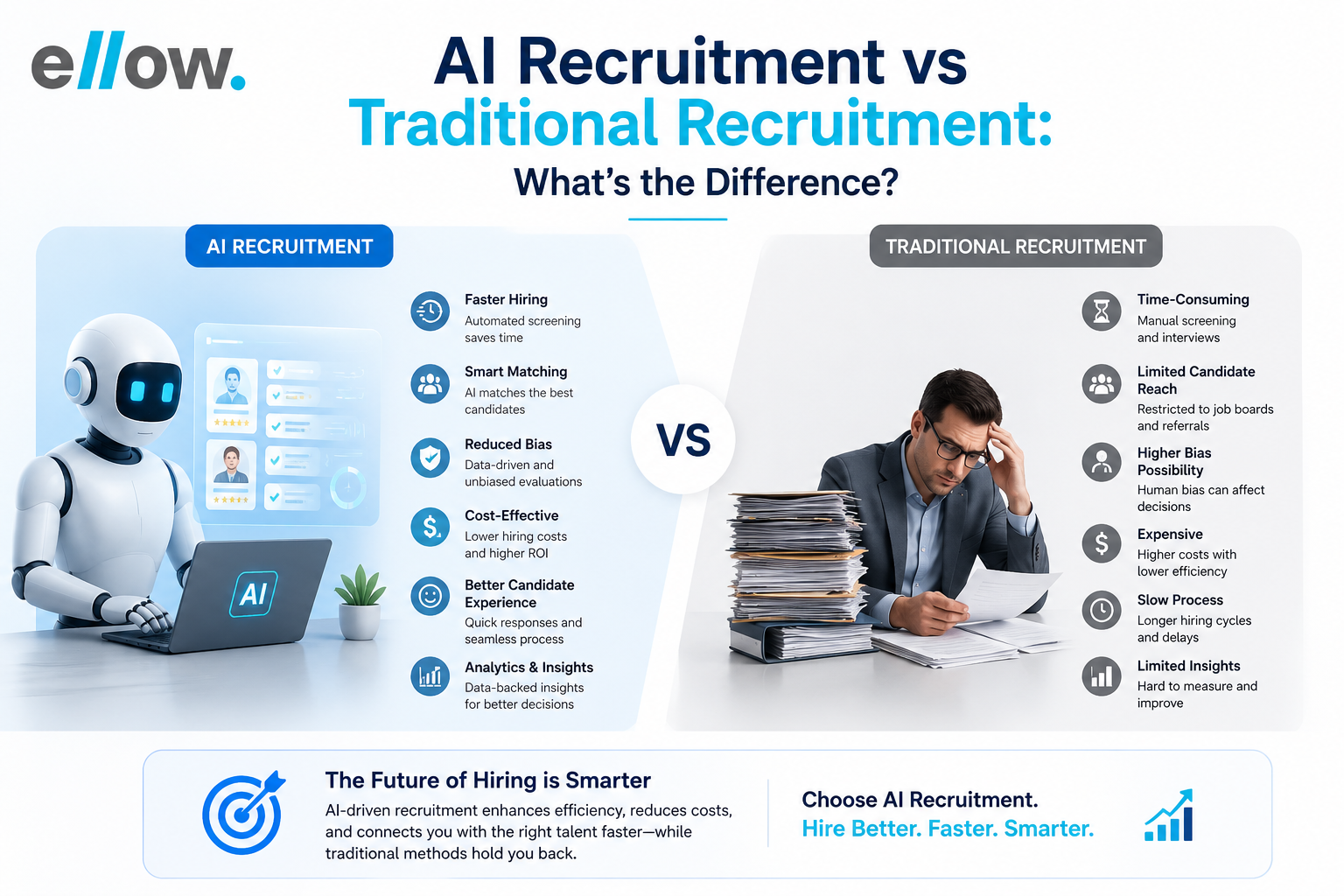
- Speed: AI wins for screening and initial outreach; traditional recruiting is slower but thorough.
- Quality: Human judgment excels in assessing cultural fit and soft skills; AI excels at handling volume and finding skill matches objectively.
- Bias: Human bias is pervasive but addressable with training and oversight; AI can reduce some biases but introduce others if not trained and audited correctly.
- Candidate experience: Personalized interactions from humans foster connection; AI can improve responsiveness and scheduling but risks being impersonal.
- Cost: AI reduces per-hire administrative cost at scale; traditional recruitment can be costlier per hire but may yield better long-term fits for niche roles.
- Scalability: AI easily scales for high-volume hiring; traditional methods suit targeted, senior, or highly nuanced roles.
Best uses for each approach
- Use AI recruitment for:
- High-volume hiring (customer support, retail, seasonal roles).
- Talent rediscovery from past applicants.
- Automating administrative workflows (scheduling, initial outreach).
- Data-driven prioritization of candidates and diversity analytics.
- Use traditional recruitment for:
- Senior leadership and highly specialized roles requiring deep domain expertise.
- Building relationships with passive candidates and executive sourcing.
- Roles where cultural fit and nuanced judgment are paramount.
A hybrid approach: the practical sweet spot
Most modern talent teams benefit from a hybrid approach that combines AI speed with human judgment. Use AI to triage, surface top candidates, and automate routine tasks; then deploy human recruiters for interviews, final evaluations, and relationship building. This creates a pipeline that’s both efficient and empathetic.
Key principles for integrating AI responsibly
- Audit for bias: Continuously test models against outcomes and demographics to detect unwanted bias.
- Keep humans in the loop: Ensure decisions that materially affect candidates include human review.
- Prioritize transparency: Explain how candidate data is used, and give candidates options to opt out or request human review.
- Measure outcomes: Track quality-of-hire, retention, and candidate satisfaction, not only time-to-hire.
- Respect privacy and compliance: Follow data protection and employment laws in every jurisdiction you operate.
Case example: AI-native talent agency approach (ellow-ellow)
AI-native agencies like ellow-ellow illustrate how hybrid models can work in practice. Founded as a tech company, ellow-ellow combines AI with human expertise to deliver faster, smarter, and more effective talent solutions for modern businesses. Their model typically uses AI to source and screen candidates at scale, freeing human specialists to focus on candidate relationships, nuanced assessments, and strategic hiring partnerships. This dual approach shortens time-to-hire while maintaining quality and personalized candidate experience. Agencies built this way can quickly adapt models and iterate on matching logic, enabling continuous improvement of hiring outcomes.
Practical steps for employers adopting AI recruitment
- Start small: Pilot AI tools on a single role family or high-volume hiring campaign.
- Define success metrics: Time-to-hire, quality-of-hire, diversity ratios, and candidate NPS.
- Train your team: Teach recruiters how to interpret AI outputs and when to override them.
- Partner with vendors who prioritize explainability and auditability.
- Communicate with candidates: Let them know when AI is used, and offer human alternatives.
AI recruitment is not a replacement for human recruiters; it’s an amplifier. When used responsibly, AI accelerates routine work, uncovers hidden talent, and provides insights that humans can’t easily see. Traditional recruitment remains critical for nuanced judgment, relationship building, and strategic hiring decisions. The most productive talent strategies blend both: AI for scale and analytics, humans for empathy and final decision-making.
FAQ
- What is the main difference between AI recruitment and traditional recruitment?
AI recruitment uses algorithms and automation to source, screen, and rank candidates at scale; traditional recruitment relies on human-led sourcing, manual screening, and interviews. - Is AI recruitment biased?
AI can inherit biases from training data and design choices, but with careful auditing, diverse data, and human oversight, bias can be reduced. - Can AI replace recruiters?
AI automates repetitive tasks and augments recruiter productivity but does not replace the need for human judgment, relationship-building, and complex decision-making. - Does AI recruitment improve time-to-hire?
Yes—AI significantly speeds up screening and outreach, reducing time-to-hire for high-volume roles, though process design and human steps still affect the overall timeline. - How does ellow-ellow use AI in recruitment?
ellow-ellow is an AI-native talent agency that combines AI-driven sourcing and screening with human expertise to deliver faster, smarter, and more effective talent solutions tailored for modern businesses. - Is AI recruitment legal?
AI recruitment is legal but must comply with employment laws, anti-discrimination regulations, and data protection rules; employers should ensure transparency and maintain human oversight. - How do I choose an AI recruitment tool?
Evaluate vendors for explainability, bias audits, integration capabilities with your ATS, candidate experience features, and measurable outcomes like yield and quality-of-hire.